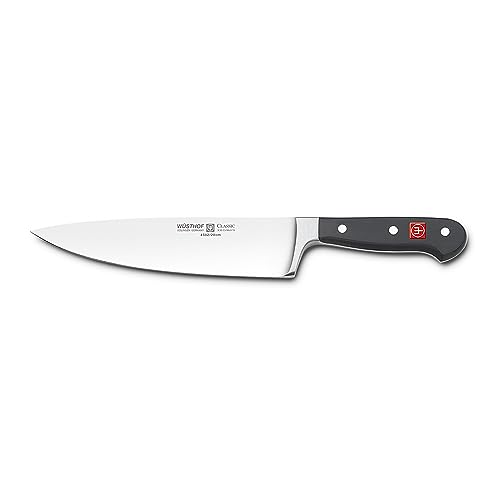
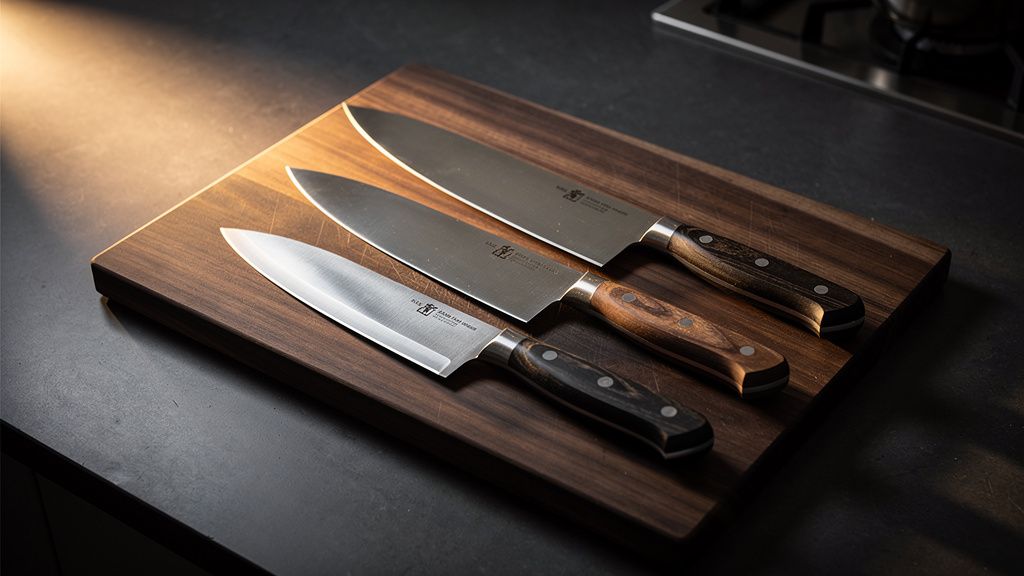
Short answer: for pure cutting performance, the ~$50 Victorinox Fibrox Pro genuinely rivals the ~$180 Wüsthof Classic — same German steel, similar hardness, comparable edge out of the box. Cook’s Illustrated has named the Victorinox its top chef’s knife for years, ahead of blades three times the price. What the Wüsthof premium buys is not sharper cuts: it’s forged heft, a bolster, a full tang, a more substantial hand feel, and a knife that looks and ages like an heirloom. If you cut for results, buy the Victorinox. If the tool in your hand matters as much as the food, the Wüsthof earns its money — for the right cook.
Victorinox vs Wüsthof at a glance
| Victorinox Fibrox Pro | Wüsthof Classic | |
|---|---|---|
| Price tier | ~$50 | ~$150-200 |
| Construction | Stamped, single-piece blade | Forged from one steel billet |
| Steel hardness | German, ~56 HRC | German, ~58 HRC |
| Bolster | None | Full forged bolster |
| Tang | Partial | Full tang, triple-riveted |
| Handle | Fibrox (textured TPE) | POM (polyoxymethylene) |
| Weight | Lighter, nimble | Heavier, blade-forward |
| Edge out of box | Sharp | Sharp |
| Edge retention | Excellent | Excellent |
| NSF certified | Yes | Yes |
| Best for | Value, pros, workhorses | Heft lovers, longevity feel |
Does the Wüsthof actually cut better?
No — and that surprises people. Both are German stainless at similar hardness (Victorinox ~56 HRC, Wüsthof ~58), ground to comparable Western edge angles near 15° per side. Out of the box, both take a tomato skin cleanly and glide through an onion. In Cook’s Illustrated blind testing, the Victorinox has repeatedly beaten knives costing three and four times as much — because the thing you pay Wüsthof extra for isn’t the edge.
Stamped versus forged is where the money story starts. The Victorinox is stamped, punched from a sheet of steel then ground and honed. The Wüsthof is forged, hammered from a single billet, which is slower, costlier, and the source of its bolster and heft. For decades “forged” was marketing shorthand for “better cuts.” It isn’t. A stamped blade with good geometry and a keen edge cuts every bit as well. Forging buys you construction, not performance.
So what does the extra $130 actually get you?
Real things — just not sharper cuts. Here is the honest ledger:
- Heft and balance. The forged Wüsthof is heavier and blade-forward, with a bolster that shifts weight toward your pinch grip — rock-chopping a pile of herbs, that mass does some of the work for you. The lighter Victorinox is more nimble and less fatiguing over a long prep session. Which you prefer is genuinely personal.
- The bolster. That thick collar where blade meets handle is a forging-only feature. It acts as a finger guard, adds balance, and gives the knife a planted, premium feel. The Victorinox skips it, leaving a clean heel you can sharpen edge-to-edge.
- Full tang. Wüsthof runs a full-width tang through the handle, triple-riveted; the Victorinox uses a partial tang inside molded Fibrox. Both survive decades of home use, but the full tang contributes to that solid, no-flex feel.
- Hand feel and looks. The Wüsthof’s polished POM handle and forged spine feel like a serious tool and look like one on the block. The Fibrox handle is textured, grippy, and frankly ugly — built for a wet professional line, not a dinner party.
- Longevity feel. Both last a lifetime with care, but the heavier forged steel gives the Wüsthof a durability feel the workmanlike Victorinox doesn’t advertise.
Notice the pattern: heft, bolster, tang, feel, looks. Not one item on that list makes the food come out better. It’s the Japanese vs German knives debate applied within a single steel tradition — you’re paying for construction and character, not cutting.
Which handle is better: Fibrox or POM?
Different jobs. The Fibrox handle is textured thermoplastic engineered for grip when wet or greasy — which is why the knife is standard issue in culinary schools and restaurant lines. It isn’t pretty, but it’s arguably safer.
The Wüsthof’s POM handle is smoother, denser, and more contoured, with a classic riveted look. In a dry home kitchen it’s comfortable and handsome; get it slick with chicken fat and it’s marginally less secure than the Fibrox. Casual and clean cooking, the POM wins on feel; fast and messy, the Fibrox wins on function.
What about edge retention and maintenance?
Near-identical, because the steel is nearly identical. Both are soft-enough German stainless that a weekly pass on a honing rod keeps them keen, and a full sharpen once or twice a year restores them completely. Neither demands a whetstone the way a hard Japanese blade does — a standard honing steel is safe on both.
This is where the value case gets brutal for the Wüsthof: a maintained Victorinox will out-cut a neglected Wüsthof every single day. The $130 premium buys you nothing if the knife lives dull in a drawer. Steel that’s honed weekly and hand-dried beats steel that’s expensive and forgotten. Whichever you buy, our knife care guide is what actually protects your investment — far more than the price tag does.
Are there better options than either?
Maybe, depending on what you value. If the Victorinox’s cutting appeals but you want forged heft and a bolster without full Wüsthof pricing, the Mercer Culinary Genesis is the forged budget alternative — German steel, a real bolster, and a Santoprene grip, for well under the Classic. If you’re set on premium German, the Zwilling Pro is the Classic’s direct rival, with a curved bolster many cooks find the most ergonomic detail in the category.
And if what actually bothers you about both is the weight, that is worth naming: the Global G-2 is a third lighter than the Wüsthof at 5.9 ounces, with a seamless all-steel body and a Japanese edge that still hones on a standard rod. It is the obvious escape route for anyone who finds German knives tiring rather than reassuring.
Our full best chef’s knives rankings puts them all side by side, and how to choose a chef’s knife walks through grip, balance, and fit so you buy for your hand, not the hype.
Who should buy which?
- Buy the Victorinox Fibrox Pro if: you want the most cutting performance per dollar, you cook a lot and value low fatigue, you’re outfitting a first kitchen, or you simply refuse to pay for aesthetics. It’s the value benchmark for a reason — a pro-kitchen staple that happens to cost $50.
- Buy the Wüsthof Classic if: you want a heavier, blade-forward knife with a bolster; you value the hand feel and heirloom character of forged steel; you’ll keep and maintain one knife for decades and want it to feel special every time you pick it up. The premium is real and honest — it just isn’t a performance premium.
- Consider the Mercer Genesis if: you want forged heft on a budget, splitting the difference.
- Consider the Zwilling Pro if: you’re already committed to premium German and want to compare bolster ergonomics before deciding.
What to skip: the block set
Whichever knife you land on, don’t buy it as part of a 15-piece block set to “save money.” Sets like the Cuisinart C77SS-15PK spread one budget across fifteen pieces, so the chef’s knife — the one you actually use every day — gets thinner steel than a single quality blade at the same total spend, padded out with steak knives you’ll rarely touch. A standalone Victorinox out-cuts the chef’s knife in almost any block set for a fraction of the money. Buy one great chef’s knife, add a serrated bread knife and a paring knife over time, and you’ve beaten the set.
Frequently asked questions
Is the Victorinox Fibrox really as good as the Wüsthof Classic?
For cutting, yes. Both use German stainless at similar hardness with comparable edges, and the Victorinox has topped blind tests against far pricier knives for years. The Wüsthof’s extra cost buys forged construction, a bolster, heft, and a premium hand feel — not measurably better cuts.
Why is the Wüsthof so much more expensive if it doesn’t cut better?
Because it’s forged rather than stamped. Forging hammers the blade from a single steel billet — slower, costlier, and what enables the bolster and full tang. You’re paying for that build, the heft, and the heirloom feel: real value for some cooks, irrelevant for others.
Stamped or forged — does it matter for a home cook?
Not for performance. A well-ground stamped blade like the Victorinox cuts as cleanly as a forged one. Forged knives are heavier and have a bolster, which changes balance and feel but not sharpness. Choose on how the knife feels in your hand, not the word “forged.”
Do I need a whetstone for either of these?
No. Both are soft-enough German steel that a standard honing rod keeps them sharp week to week, with a full sharpen once or twice a year. Neither requires a whetstone the way a hard Japanese knife does — though one will restore either to like-new when the edge finally wears.
Which lasts longer, the Victorinox or the Wüsthof?
Both last a lifetime with basic care — hand wash, dry, hone, never the dishwasher. The Wüsthof feels more durable thanks to its heavier forged build, but a maintained Victorinox will still be cutting decades from now. Maintenance decides longevity far more than price does.