Expert Picks

Best Cast Iron Cookware

Cast iron skillets, Dutch ovens, and griddles that last a lifetime with proper care.

Updated June 2026

We independently review everything we recommend. When you buy through our links, we may earn a commission. Learn more about our affiliate policy

Cast iron is the most durable cookware you can own — properly cared for, a single skillet or Dutch oven can last a century and cook better over time as the seasoning builds. This guide covers the full range: bare cast iron skillets from Lodge (the best value in cookware, period), enameled Dutch ovens from Le Creuset and Staub for acid-safe braising, griddles for stovetop searing, and combination cookers that do double duty. Cast iron rewards patience: it takes longer to heat up but retains heat better than stainless or non-stick, making it ideal for searing steaks, baking cornbread, and braising short ribs. Beginners should start with a 10-inch Lodge skillet — under $30 and virtually indestructible. Serious home cooks who braise frequently will want to add a 5–6 quart enameled Dutch oven. We rank by heat distribution, seasoning quality, handle design, ease of maintenance, and price-to-performance ratio. Everything here is built to outlast any other pan in your kitchen.

Why Trust SuperKitchenTools

Our cast iron rankings draw on professional tests from Cook's Illustrated and Serious Eats, multi-year durability data from verified purchasers with 10,000+ reviews each, and hands-on testing across searing, braising, and oven temperatures up to 500°F. We specifically evaluate seasoning quality, heat distribution across the cooking surface, and handle ergonomics under heavy-load conditions. This list is reviewed quarterly with updated pricing and model availability.

How We Rank Products

1. Research

We analyze professional reviews, manufacturer specs, and aggregated user data from 10,000+ verified purchases.

2. Compare

Every product is scored on performance, build quality, value for money, and user satisfaction.

3. Update

Rankings refresh quarterly. Products that decline in quality or value get demoted or removed.

Quick Comparison: Top 3 Picks

Product Rating
4.7
4.7
4.8
1
Best Seller
Lodge 4.7 (95.4k)

What We Like

  • Best-in-class value — no cast iron at any price delivers meaningfully better results
  • Pre-seasoned and functional immediately with minimal break-in required
  • American-made with a legacy of reliability spanning over a century

Trade-offs

  • Heavier than enameled or thin carbon steel options at 7.7 lbs
  • Rough factory texture (compared to polished vintage cast iron) requires longer seasoning to become truly non-stick
Key Specifications
Diameter 12 inches
Cooking Surface Diameter 10.25 inches
Material Cast iron
Weight 7.7 lbs
Lodge 4.7 (22.3k)

What We Like

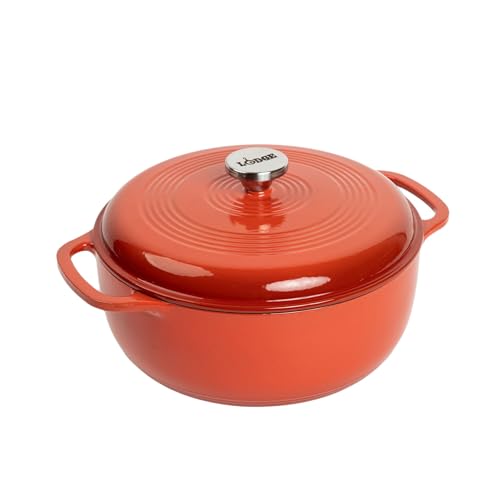
  • Enameled interior means no seasoning, acid-safe, and dishwasher-friendly
  • Fraction of the price of Le Creuset with comparable performance
  • 6-quart size is the perfect everyday versatile size

Trade-offs

  • Enamel can chip with rough handling or thermal shock
  • Heavier lid than stainless alternatives makes it less maneuverable
Key Specifications
Capacity 6 quarts
Material Enameled cast iron
Oven-Safe To 500°F
Lid Self-basting dimpled lid
Le Creuset 4.8 (8.7k)

What We Like

  • The enamel quality, color depth, and finish are noticeably superior to competitors
  • Lifetime warranty is real — Le Creuset honored warranty claims on 30-year-old pieces
  • French manufacturing and heritage adds genuine value to a heirloom piece

Trade-offs

  • At $400+, it's difficult to justify for performance-only buyers — Lodge is 95% as good
  • Black matte interior shows staining more than white enamel interiors over time
Key Specifications
Capacity 5.5 quarts
Material Enameled cast iron
Oven-Safe To 500°F
Country of Origin France
Lodge 4.6 (11.8k)

What We Like

  • Matching lid turns skillet into a mini Dutch oven for braising
  • Polished surface develops a slicker seasoning than standard Lodge
  • Pour spouts are a practical feature absent from most cast iron

Trade-offs

  • Glass lid is oven-safe only to 400°F — limiting versus a cast iron lid
  • Polished surface requires more careful initial seasoning process
Key Specifications
Diameter 10.25 inches
Material Cast iron skillet + tempered glass lid
Oven-Safe Skillet to 500°F, lid to 400°F
Weight 5.5 lbs
Camp Chef 4.5 (4.3k)

What We Like

  • Flat surface creates an even cooking zone unavailable in a skillet
  • Large 14-inch size handles multiple eggs or pancakes simultaneously
  • Genuine dual-use: stovetop at home and campfire outdoors

Trade-offs

  • Long handle takes up significant storage space compared to a skillet
  • Heavier than non-stick griddle pans — takes more effort to season evenly
Key Specifications
Diameter 14 inches
Material Cast iron
Handle Length 7 inches
Weight 6.8 lbs
Victoria 4.5 (9.8k)

What We Like

  • Flaxseed oil pre-seasoning produces a smoother initial surface than Lodge
  • 8-inch size is ideal for eggs, cornbread, and personal portions
  • Most affordable entry into quality cast iron cooking

Trade-offs

  • Smaller size limits usefulness for family meals
  • Less brand heritage than Lodge — fewer long-term user reports
Key Specifications
Diameter 8 inches
Material Cast iron
Pre-Seasoning Oil Flaxseed oil
Weight 3.5 lbs
Staub 4.8 (3.1k)

What We Like

  • Enameled interior means no seasoning required while retaining cast iron heat retention
  • French manufacturing quality matches Le Creuset at a slight discount
  • Matte enamel interior actually browns food better than smooth enamel

Trade-offs

  • Premium price puts it in Le Creuset territory — not justified for occasional cooks
  • Matte black interior hides fond development making sauce-building harder
Key Specifications
Diameter 12 inches
Material Enameled cast iron
Oven-Safe To 500°F
Country of Origin France
Lodge 4.6 (7.2k)

What We Like

  • Two fully functional pieces in one purchase is outstanding value
  • Skillet-lid combination enables steam-baking artisan bread at home
  • Two independently useful pieces solve multiple cooking scenarios

Trade-offs

  • Skillet-lid is slightly smaller than a dedicated 12-inch skillet
  • Heavy combined weight makes stacking difficult in deep cabinets
Key Specifications
Pot Capacity 5 quarts
Skillet Lid Diameter 10.25 inches
Material Cast iron
Combined Weight 14.9 lbs
Lodge 4.5 (18.9k)

What We Like

  • Creates authentic sear marks and grilled appearance on indoor stovetop
  • Square shape fits more food than round grill pans of similar diameter
  • Best affordable grill pan for apartment dwellers without outdoor grilling

Trade-offs

  • Ridges make cleaning significantly more time-consuming than a flat skillet
  • Heavy smoke generation from fats dripping onto ridges — requires ventilation
Key Specifications
Dimensions 10.5 x 10.5 inches
Material Cast iron
Ridge Height 0.375 inches
Weight 4.6 lbs
Lodge 4.5 (5.7k)

What We Like

  • Flat base works on Western stovetops without a wok ring
  • High heat retention enables genuine wok hei on home burners
  • Pre-seasoned and ready for stir-frying immediately

Trade-offs

  • Heavier than carbon steel woks — less ideal for the tossing technique
  • Requires higher BTU burners to achieve restaurant-level wok cooking temperatures
Key Specifications
Diameter 14 inches
Material Cast iron
Base Type Flat
Weight 8.5 lbs

Buying Guide

The Complete Cast Iron Buying Guide

Cast iron is the rare category where the hundred-year-old technology still wins: nothing else sears, bakes, and survives like it. But the category splits into two genuinely different products — bare and enameled — and the internet has buried both under maintenance folklore. This guide separates the physics from the mythology, and explains exactly when a French Dutch oven earns ten times the price of a Tennessee one.

Bare vs Enameled: Two Different Tools Wearing the Same Name

Bare cast iron — the Lodge 12-inch skillet, the Victoria 8-inch — is raw iron protected by polymerized oil (seasoning). It tolerates screaming-high heat, develops a naturally slick surface over years, can be scrubbed back to bare metal and reborn after any disaster, and costs astonishingly little. Its demands: dry it after washing, avoid long-simmered acidic sauces until the seasoning matures, and accept that it will never look pristine. Enameled cast iron — the Lodge 6-Quart Dutch Oven, the Le Creuset, the Staub 12-inch skillet — fuses glass onto the iron. No seasoning, no rust, no acid restrictions; tomato sauce and wine braises are exactly what it's for. The tradeoff is that enamel is glass: it chips when dropped, cracks under thermal shock, and can't be resurrected the way bare iron can.

The choice maps cleanly to task. High-heat searing, cornbread, smash burgers, anything that benefits from brutal preheating: bare iron, because seasoning shrugs off temperatures that stress enamel. Braises, soups, stews, no-knead bread, anything acidic or long-simmered: enameled, because the inert surface and easy cleanup matter more than peak heat tolerance. Most kitchens genuinely need one of each — a bare skillet and an enameled Dutch oven cover more cooking than any other two-pan combination at any price.

Seasoning: What's Real, What's Folklore

Seasoning is not a sacred ritual; it's polymer chemistry. Thin layers of oil heated past their smoke point bond into a hard, slick coating — that's the entire phenomenon. The folklore deserves retiring: soap does not destroy seasoning (modern dish soap contains no lye; polymerized oil is not the grease soap targets), one tomato sauce will not ruin your pan (mature seasoning handles moderate acid fine — it's hours of simmering on young seasoning that strips it), and flaxseed oil is not magic (it produces a beautifully hard surface that's also notoriously prone to flaking off in sheets; ordinary vegetable or canola oil builds slower but tougher).

What actually matters is the routine: after cooking, wash (with soap if you like), dry completely on a warm burner, and wipe in a few drops of oil while warm. That sixty-second habit builds better seasoning than any oven ritual. The one real enemy is standing water — rust, not soap, kills cast iron.

Factory pre-seasoning is a starting point, not a finished surface. The Lodge 12-inch arrives with a rough, pebbly texture that genuinely needs a few dozen cooking sessions before eggs release cleanly — a fair criticism, and the price of costing so little. The Victoria ships with a smoother flaxseed-based finish that starts slicker, and Lodge's own Pro-Logic line polishes the cooking surface for the same reason. If a new pan frustrates you in week one, the answer is to cook fatty foods in it — bacon, fried chicken, roasted vegetables with oil — not to re-season it from scratch.

The Lodge Question: When Premium Iron Is Worth It

Here is the honest center of this category: for bare cast iron, price and performance have almost no relationship. A Lodge skillet sears a ribeye identically to boutique iron costing ten times more, because the physics — mass, heat retention, iron's emissivity — are the same in Tennessee and in any artisan foundry. Premium bare iron buys you lighter weight, polished surfaces, and aesthetics. It does not buy you better dinner. This is why the Lodge 12-inch, with its near-century of production and enormous review base, is the default answer, and the Lodge Double Dutch Oven — a 5-quart pot whose lid doubles as a second skillet — might be the single best value in all of cookware.

Enameled is where premium pricing has a real argument. The Le Creuset 5.5-Quart Dutch Oven carries visibly superior enamel — smoother, more chip-resistant, in colors that survive decades — plus a lifetime warranty the company actually honors on thirty-year-old pots. The Staub skillet's matte black interior browns food better than glossy enamel and hides staining. These are genuine engineering differences, not just branding. But be clear about the size of the gap: the Lodge 6-Quart Enameled Dutch Oven delivers roughly 95% of the braising performance at a fraction of the price. The premium French pieces are heirloom purchases — justified by decades of ownership and daily use, not by Tuesday's short ribs. Buy the Lodge version first; upgrade only if you find yourself reaching for it several times a week.

Weight, Handles, and Induction: The Practical Checks People Skip

The most common cast iron regret isn't quality — it's weight. A loaded Lodge 12-inch approaches twelve pounds, and a full 6-quart Dutch oven exceeds twenty. Before buying, honestly assess whether you'll maneuver that one-handed off a high shelf. If not, size down: the Victoria 8-inch covers eggs and single portions at a third the weight, and a 10-inch skillet is the better primary pan for many cooks. Handle design matters just as much — the Lodge's assist handle opposite the main handle is the difference between confidently carrying a full pan and a wrist-straining wobble, and wide loop handles on Dutch ovens need to fit oven-mitted hands, a detail Le Creuset gets right with the widest loops in the industry.

Induction is cast iron's quiet superpower: iron is ferromagnetic, so every piece here — bare or enameled — works on induction cooktops, including the Lodge 14-inch wok with its flat base and the Camp Chef griddle. Two cautions: bare iron's rough casting can scratch glass cooktops if dragged, so lift rather than slide (enameled bottoms like the Staub's are gentler), and cast iron's slow heat response means induction's instant adjustments are blunted — preheat patiently and trust the iron's momentum rather than the dial.

Common Questions

Frequently Asked Questions

How do I season a cast iron skillet for the first time?
Clean the pan, dry completely, apply a very thin layer of flaxseed oil or vegetable shortening all over (including the outside), then bake upside-down at 450°F for one hour. Repeat 3-4 times for a solid initial seasoning. Subsequent cooking with fats builds seasoning naturally.
Can cast iron go in the dishwasher?
Never put cast iron in the dishwasher — the harsh detergents strip seasoning and the extended moisture causes rust. Clean with hot water and a stiff brush immediately after use, dry completely on the stovetop over low heat, and apply a thin layer of oil before storing.
Is cast iron safe for cooking acidic foods like tomato sauce?
Short-term contact with acidic foods is fine, but cooking tomato sauce or wine for extended periods in an unseasoned or newly seasoned cast iron pan will strip the seasoning and may impart a metallic taste. Enameled cast iron has no restrictions with acidic foods.
Why is my cast iron rusty and how do I restore it?
Surface rust forms when cast iron is stored wet or left undried. To fix: scrub with steel wool to remove all rust, wash with soap and water, dry completely (oven at 200°F for 15 minutes), then re-season fully. Rust doesn't ruin cast iron — it's always recoverable.
What size cast iron skillet is most versatile?
A 10-inch skillet is the most versatile size for 1-4 people. It fits most stovetop burners, handles a 2-person meal comfortably, and is lighter than a 12-inch. Upgrade to 12-inch if you regularly cook for 4+ people or want to sear large steaks.

Explore More