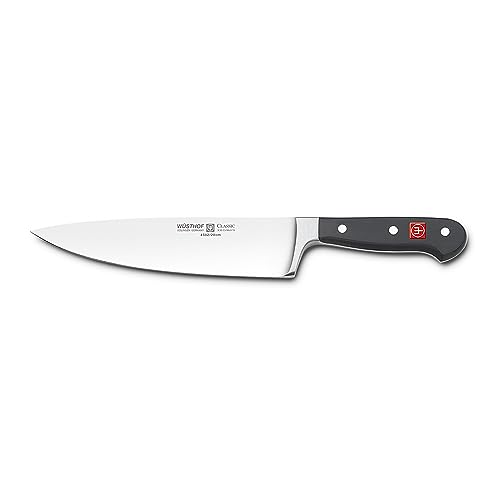
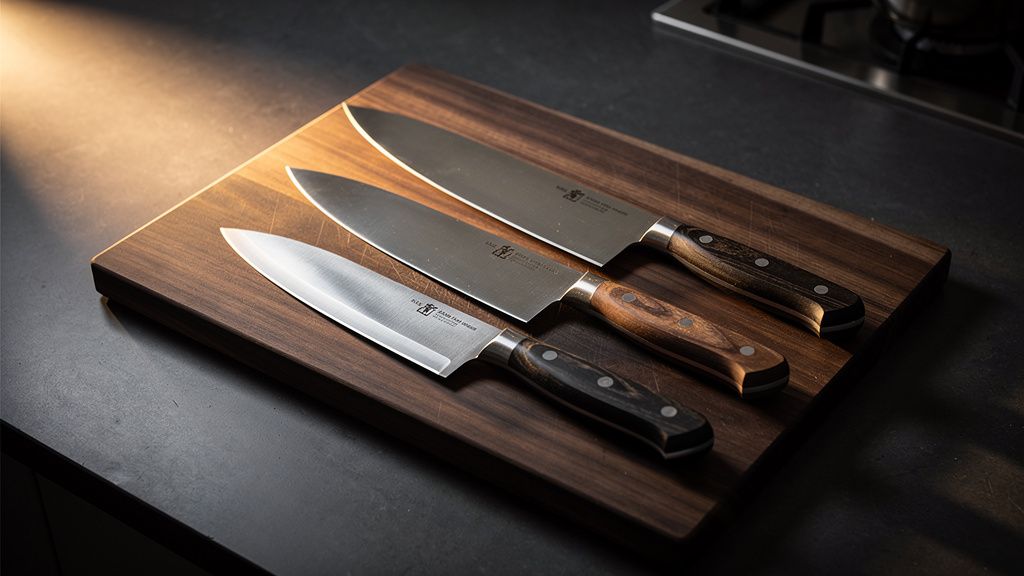
Short answer: buy a German knife (Wüsthof, Zwilling) if you want a tough, forgiving all-rounder that shrugs off abuse and resharpens in seconds. Buy a Japanese knife (Shun, Tojiro, MAC, Global) if you cut mostly vegetables, fish, and boneless proteins and want a sharper edge that lasts far longer. Neither is “better” — they are two different philosophies of steel, and the right pick depends on how you cook and how much maintenance you will actually do.
Japanese vs German knives at a glance
| German | Japanese | |
|---|---|---|
| Steel hardness | Softer (~56-58 HRC) | Harder (~60-63 HRC) |
| Edge angle | Wider (~15-20° per side) | Finer (~10-15° per side) |
| Sharpness out of box | Sharp | Sharper |
| Edge retention | Shorter — touch up often | Longer — holds for weeks |
| Durability | High — tolerates bones, twisting | Lower — hard steel can chip |
| Weight | Heavier, blade-forward | Lighter, nimble |
| Maintenance | Honing rod weekly, easy | Whetstone needed, less forgiving |
| Best for | Rock-chopping, all-purpose, beginners | Precision push-cuts, vegetables, fish |
| Price range | Mid to premium | Budget to premium |
What’s the real difference between Japanese and German knives?
It comes down to steel hardness, measured on the Rockwell scale (HRC). German knives use softer steel around 56-58 HRC; Japanese knives run harder, roughly 60-63 HRC. Everything else follows from that one number.
Softer German steel is ground into a thicker blade with a wider edge angle. It dulls faster but resists chipping, tolerates the occasional chicken bone or squash, and comes back to sharp with a few passes on a honing rod. The Wüsthof Classic and Zwilling Pro are the archetypes: heavier, blade-forward, built to take a beating.
Harder Japanese steel takes a finer, more acute edge and holds it dramatically longer. The trade-off is brittleness: twist a Shun Classic or Tojiro DP against a frozen edge or a bone and you can chip it. These blades reward precise, downward cuts and careful owners.
A few knives deliberately blur the line. The MAC MTH-80 pairs Japanese hardness with a slightly more forgiving Western profile, which is why it lands in pro kitchens on both sides of the divide. The Global G-2 is all-stainless and very light, with steel soft enough to maintain on a rod — Japanese looks, near-German behaviour.
Which holds an edge longer?
Japanese, clearly — and it is not close. Harder steel means the edge stays keen for weeks of normal use where a German blade wants a touch-up every few days. America’s Test Kitchen and Cook’s Illustrated have shown this repeatedly in edge-retention testing.
But edge retention cuts both ways. When a Japanese edge finally dulls, restoring it needs a whetstone, because a standard honing steel can chip steel above 60 HRC. A German edge, by contrast, realigns in ten seconds on a honing rod and only needs a full sharpening every 6-12 months. So “holds an edge longer” and “easier to keep sharp” are different questions with opposite answers.
Which is easier to maintain?
German, for most home cooks. The maintenance routine is forgiving: hone weekly on a rod, sharpen once or twice a year, hand wash and dry. The softer steel tolerates mistakes.
Japanese knives demand more: a whetstone (and the willingness to learn it), gentler use, and immediate drying since some carbon-bearing blades can spot. If you enjoy the ritual, this is a feature. If “maintenance” means you will toss the knife in a drawer and forget it, German steel will serve you better — and here is the part nobody says out loud: a maintained budget knife outperforms a neglected premium one every time. A $50 Victorinox Fibrox Pro that gets honed weekly will out-cut a $200 Shun that never meets a stone.
Are Japanese knives better than German knives?
No — “better” depends entirely on your cooking. Japanese knives are better at precision: thin slices, fine vegetable work, fish, clean push-cuts with less effort. German knives are better at versatility and abuse: rock-chopping herbs, breaking down a chicken, handing the knife to a houseguest without wincing. Professional kitchens run both, often on the same line, because they are tools for different jobs, not rungs on a quality ladder.
Which should you choose?
- Total beginner / shares the kitchen: German. Forgiving, durable, easy to maintain. Start with the Wüsthof Classic, or save with the Victorinox Fibrox Pro (a pro-kitchen staple at a fraction of the price).
- Confident cook who preps lots of produce: Japanese. The MAC MTH-80 is the do-everything pick; the Tojiro DP is the best value in genuine VG-10 Japanese steel.
- You want sharp-and-light without whetstone homework: the Global G-2 — Japanese feel, rod-friendly steel.
- You hone but do not want to sharpen often: German workhorse like the Zwilling Pro, whose curved bolster is the best ergonomic detail in its class.
- On a budget: skip the brand debate entirely. The Victorinox or Mercer Culinary Genesis cut with knives three times the price.
Still unsure where to start? Our how to choose a chef’s knife guide walks through grip, balance, and fit, and the full best chef’s knives ranking compares every pick side by side.
What to skip: the knife block set
Whichever camp you land in, do not buy a 15-piece block set to get there. Sets like the Cuisinart C77SS-15PK spread their budget across fifteen pieces, so each knife gets cheaper steel than a single quality blade at the same total price — you end up with a mediocre chef’s knife (the one you use daily) and six steak knives you barely touch. Buy one excellent chef’s knife, add a serrated bread knife and a paring knife, and you have outcooked any block set for less. Then protect your investment: never put any of these knives in the dishwasher (see our knife care guide).
Frequently asked questions
Do professional chefs use Japanese or German knives?
Both. Many Western-trained chefs grew up on German knives and still reach for them for heavy tasks, while sushi and precision-focused cooks favour Japanese blades. It is common to see a chef own a German workhorse and a Japanese knife for fine work — the choice is about the task, not prestige.
Can you sharpen a Japanese knife on a regular honing steel?
Not safely. Hard Japanese steel (60+ HRC) can chip against a standard steel rod. Use a whetstone, a fine ceramic rod made for hard steel, or a professional sharpening service. German knives, being softer, are fine on a normal honing rod.
Why are Japanese knives so sharp?
Harder steel can hold a finer, more acute edge angle (roughly 10-15° per side versus 15-20° for German). That thinner geometry slices with less resistance, which is why a Japanese knife feels noticeably sharper through a tomato or onion.
Are German knives better for beginners?
Generally yes. Their softer steel is more forgiving of bones, twisting, and cutting-board contact, and they are easier to keep sharp with a simple honing rod. That durability makes them lower-stress while you build knife skills.
Is an expensive chef’s knife worth it?
Up to a point. A mid-range knife ($50-$150) is the value sweet spot for home cooks. Above that, you mostly pay for materials, finish, and prestige rather than meaningful cutting performance — and a well-maintained budget knife beats a neglected premium one regardless of price.