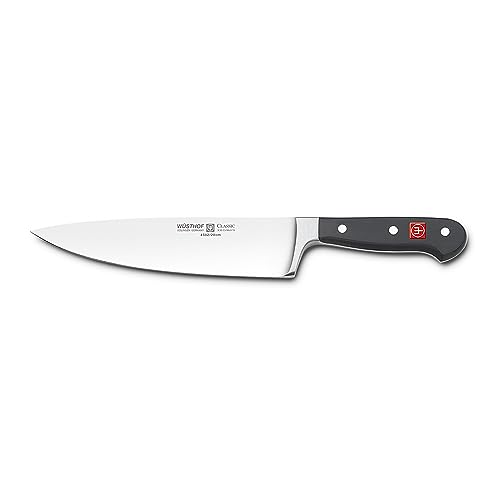
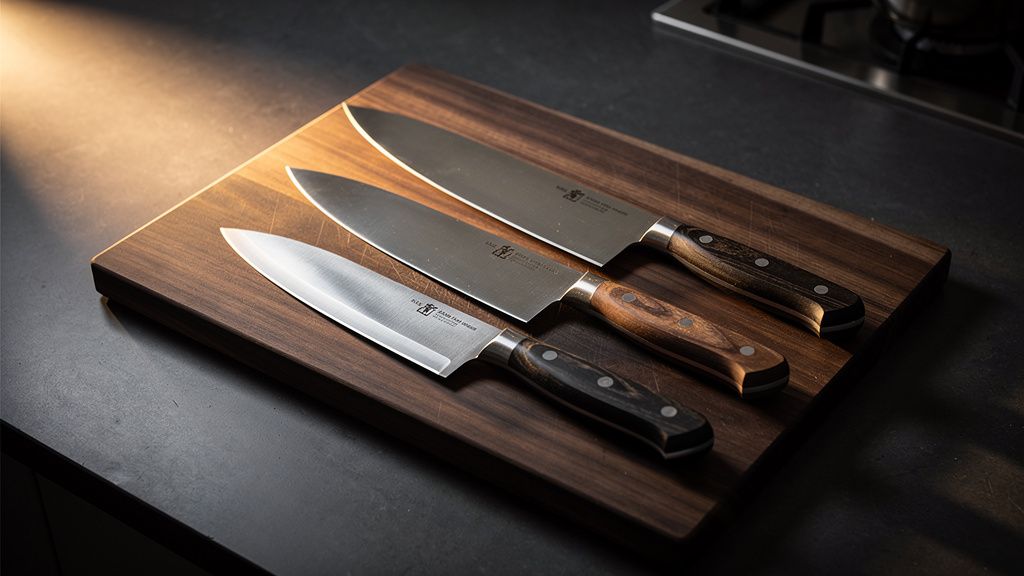
Buy the 8-inch Victorinox Fibrox Pro. It’s around $50, it’s what culinary schools hand students, and it will do 90% of everything you cut for the next twenty years. If you want a little more heft and a real bolster on roughly the same budget, the Mercer Culinary Genesis is the forged alternative. And if you already know cooking is going to stick — you cook most nights, you like the ritual — the Wüsthof Classic is the upgrade worth making once, not the knife to start with.
The beginner picks at a glance
| Knife | Type | Weight / feel | Maintenance | Best for |
|---|---|---|---|---|
| Victorinox Fibrox Pro 8” | Stamped, German steel | Light, nimble, grippy | Honing rod weekly | Almost every first-time buyer |
| Mercer Genesis 8” | Forged, German steel | Medium, real bolster | Honing rod weekly | Wanting forged heft on a budget |
| Wüsthof Classic 8” | Forged, German steel | Heavier, blade-forward | Honing rod weekly | Committed cooks, buy-once upgrade |
| Zwilling Pro 8” | Forged, German steel | Heavy, curved bolster | Honing rod weekly | Comfort-first premium German |
| Global G-2 8” | Stamped, Japanese-made | Very light, thin handle | Rod-friendly, gentler use | Small hands, wrist or grip concerns |
What size chef’s knife should a beginner buy?
Eight inches. Not six, not ten.
A 6-inch blade feels safer and is what nervous beginners reach for, but it runs out of blade fast. Halving a butternut squash, slicing a cabbage, portioning a chicken — the knife is suddenly too short and you start sawing, which is exactly when people cut themselves. A 10-inch blade solves that but is unwieldy on a small board and genuinely intimidating for the first few months.
The 8-inch is the size professional kitchens standardised on because it clears almost every ingredient in one pass while still fitting a normal home cutting board. Get one, use it for everything, and only add a second size once you know what you actually miss. Pair it with a board that gives you room — our best cutting board materials guide covers what to buy, and why glass boards destroy edges.
Should a beginner start with a German or Japanese knife?
German, or something that behaves like it. This is the single most useful piece of advice for a first knife and it gets buried under brand talk.
German knives use softer steel, roughly 56-58 on the Rockwell scale. Softer steel dulls a bit faster, but it forgives you: it tolerates hitting a bone, twisting through a squash, scraping the board with the edge instead of the spine. When it dulls, ten seconds on a honing rod brings it back. Nothing about maintaining it requires a skill you don’t yet have.
Hard Japanese steel at 60-63 HRC holds a stunning edge far longer, but it chips. It also can’t safely be honed on a standard steel rod, which means the maintenance answer is “learn to use a whetstone” — a real skill, and a bad first homework assignment. Buy that knife later, deliberately, when you know how you cut. The full breakdown lives in our Japanese vs German knives guide.
The one sensible exception: if you have small hands, wrist pain, or grip strength concerns, the Global G-2 is a Japanese-made knife that’s unusually light and made of steel soft enough to hone on a normal rod. Japanese looks, near-German upkeep.
Does the brand matter, or the handle?
The handle. Emphatically the handle.
Every knife in the table above cuts well. What separates a knife you use daily from one that lives in a drawer is whether it disappears in your hand, and that’s a fit question, not a brand question.
Hold the knife in a pinch grip: thumb and index finger pinching the blade itself just ahead of the handle, remaining three fingers wrapped around the handle. It puts your hand at the knife’s balance point, gives you far more control of the tip, and turns the blade into an extension of your forearm rather than a hammer you’re swinging. Learn it on day one.
Once you grip that way, two things start to matter:
- Balance. A knife that balances near the pinch point feels weightless. Blade-forward knives like the Wüsthof Classic let gravity do some of the chopping for you; lighter knives like the Victorinox fatigue you less over an hour of prep. Neither is correct — it’s preference.
- What your fingers touch. The Victorinox’s Fibrox handle is textured plastic engineered to stay grippy when wet and greasy. It is not beautiful. It is very hard to drop. The Zwilling Pro has a curved bolster that many cooks call the most comfortable pinch grip in the category. Those details will affect your cooking more than the logo will.
If you can, hold a few in a store before buying. If you can’t, start with the Victorinox — it’s the least likely knife to feel wrong, and at $50 it’s a cheap way to learn your own preferences. Our how to choose a chef’s knife guide goes deeper on fit.
What should you buy instead of a knife block set?
Three knives. That’s the whole starter kit, and you don’t need to buy them on the same day.
- An 8-inch chef’s knife. Roughly 90% of your cutting. Buy this one first and use it alone for a month.
- A serrated bread knife. The one job a chef’s knife genuinely can’t do. Serrations saw through crust and tomato skin without crushing what’s underneath, and because it works by tearing rather than slicing, a cheap one is fine.
- A paring knife. Small, in-hand work: hulling strawberries, deveining shrimp, peeling apples off the board. Also fine to buy cheap.
The chef’s knife is where your money goes. The other two are utility items where spending more buys almost nothing. Add a honing rod and you’ve out-equipped a fifteen-piece block set for less money, in less drawer space, with better steel on the knife you actually pick up. When you’re ready to compare models, our best chef’s knives rankings puts every option side by side.
What to skip: the block set trap and the expensive-knife fallacy
Two mistakes cost beginners the most money, and they’re related.
The 15-piece block set. A set like the Cuisinart C77SS-15PK looks like the efficient way to equip a kitchen — one purchase, everything covered, a handsome block on the counter. But that budget gets divided fifteen ways. The chef’s knife, the one knife you’ll touch every single day, ends up with thinner, cheaper steel than a single quality blade at the same total spend, subsidised by six steak knives and a boning knife you will never take out of the block. You are paying for wood and quantity, not for the edge you use.
“An expensive knife will make me a better cook.” It won’t, and the evidence is blunt: Cook’s Illustrated and America’s Test Kitchen have named the ~$50 Victorinox Fibrox Pro their top chef’s knife across years of blind testing, beating blades at three and four times the price. Above roughly $150, you’re buying construction, finish, and hand feel — real things, but not sharper cuts. That’s the whole argument in our Victorinox vs Wüsthof comparison.
Here’s the line that matters most for a beginner: a maintained $50 knife out-cuts a neglected $200 one, every day, without exception. Sharpness is a habit, not a purchase. Which brings us to the only two habits you need.
What maintenance actually matters for a beginner?
Two things. Everything else is optional.
Hone it weekly. A honing rod doesn’t sharpen — it straightens the microscopic edge that folds over during normal cutting. Six to eight light passes per side, alternating, held at roughly 15-20 degrees. Ten seconds. Do it every week or so and your knife will feel new for months. This is the habit that separates people who love their knife from people who think all knives get dull. Soft German steel is ideal for it; a hard Japanese blade is not, which is another reason to start German.
Never the dishwasher. Not once. High heat and harsh detergent pit the steel, degrade handle materials, and the knife rattles against other items and dings its edge. Wash by hand with soap, dry immediately, store it in a block, on a magnetic strip, or in a blade guard — anywhere but loose in a drawer full of metal. Our knife care guide covers full sharpening, which you’ll only need once or twice a year.
That’s the entire maintenance burden of a good chef’s knife: a rod once a week, a hand wash after use. Both take less time than the ritual of complaining about a dull knife.
Frequently asked questions
What is the best chef’s knife for a beginner?
The 8-inch Victorinox Fibrox Pro. It’s around $50, uses forgiving German steel, has a grippy handle designed for wet professional kitchens, and has topped blind tests against knives costing four times as much. It’s the safest first purchase in the category and a knife plenty of cooks never feel the need to replace.
How much should I spend on my first chef’s knife?
About $50 is genuinely enough. The $50-$150 band is the value sweet spot for home cooks, and there’s no need to enter it on your first knife. Spend $50, cook with it for a year, and you’ll know exactly what you’d want different in an upgrade — which is worth far more than guessing at $200.
Is an 8-inch chef’s knife too big for a beginner?
No. It looks large in the box and feels normal within a week. A shorter 6-inch blade runs out of length on cabbage, squash, and melon, which forces sawing motions that are less safe than a confident cut with the right size blade. Learn the pinch grip and 8 inches will feel controllable quickly.
Do I need a whetstone as a beginner?
No. Start with a honing rod, which costs little and takes ten seconds a week. Soft German steel realigns beautifully on a rod and only needs a full sharpen once or twice a year — which you can send out to a service or learn later. Whetstone skills become necessary only if you buy a hard Japanese knife.
Should I buy a knife set or a single chef’s knife?
A single chef’s knife, then add a serrated bread knife and a paring knife over time. A block set divides one budget across fifteen pieces, so the chef’s knife you use daily gets weaker steel than a standalone blade at the same price, padded out with items you rarely use. Three good knives beat fifteen mediocre ones.