

Best Seller
Victorinox
Victorinox Fibrox Pro 8-Inch Chef's Knife
Exceptional value — professional performance at a fraction of the cost of German knives
We independently review everything we recommend. When you buy through our links, we may earn a commission. Learn more about our affiliate policy
By SuperKitchenTools Editorial Team · Updated March 2026
The Global G-2 is the right knife if you want a light, agile blade and dislike the heft of German knives — at 5.9 ounces it weighs roughly a third less than a Wüsthof Classic, and cooks with wrist strain or long prep sessions notice that immediately. It is the wrong knife if you want a traditional bolster, a warm handle in cold hands, or steel that holds an edge for months. The all-steel body and dimpled grip divide people sharply, so the honest recommendation is to hold one before committing.
| Blade Length | 8 inches |
| Blade Material | CROMOVA 18 stainless steel |
| Handle Material | CROMOVA 18 stainless steel |
| Weight | 5.9 oz |
| Hardness | 56-58 HRC |
Iconic seamless design eliminates food and bacteria trapping spots
This is one of the standout qualities that sets the Global G-2 8-Inch Chef's Knife apart from similarly priced competitors.
Exceptionally light — ideal for cooks with wrist or joint issues
This is one of the standout qualities that sets the Global G-2 8-Inch Chef's Knife apart from similarly priced competitors.
Unique aesthetic stands out from traditional German and Japanese knives
This is one of the standout qualities that sets the Global G-2 8-Inch Chef's Knife apart from similarly priced competitors.
Dimpled handle can be slippery when wet without extra grip awareness
Worth knowing before you buy — though for most users this won't be a dealbreaker given the overall quality.
CROMOVA steel requires more frequent honing than higher-HRC steels
Worth knowing before you buy — though for most users this won't be a dealbreaker given the overall quality.
The Global G-2 8-Inch Chef's Knife is a strong choice for home cooks who want iconic seamless design eliminates food and bacteria trapping spots in the chefs knives category. It delivers cromova 18 stainless steel construction — entire knife including handle is one material and is well-suited to anyone who cooks regularly and wants a dependable, high-quality tool. Check current prices on Amazon to see if it fits your budget.
Most chef's knives are a blade bonded to a separate handle of wood, composite, or moulded plastic. The G-2 is one continuous piece of stainless steel from tip to butt, with the handle hollowed out and filled with sand to balance it. That single design decision drives everything people love and hate about this knife.
The upside is hygiene and durability: there is no seam where the blade meets the handle, so nothing collects food, moisture, or bacteria, and there is no join that can loosen after years of washing. Restaurant kitchens have used Globals since the mid-1980s partly for this reason. The downside is that steel conducts temperature and gets slippery when wet, which is exactly why Global covered the handle in those dimples.
Yoshikin has produced this design in Niigata, Japan since 1985, and it has barely changed. That longevity matters when you are judging a knife: a design that survives forty years of professional use without revision is not a gimmick.
At 5.9 ounces, the G-2 is one of the lightest full-size chef's knives on the market. A Wüsthof Classic 8-inch runs around 8.5 ounces, a Dalstrong Gladiator closer to 9. That difference is not a spec-sheet curiosity; it changes technique.
Heavy German knives cut partly through momentum. You lift, and the blade's own mass helps drive it down through a carrot. Light Japanese knives like the G-2 cut through edge geometry instead, which means you guide the blade rather than drop it. Cooks who learned on heavy knives often report the G-2 feels 'too light' for the first week, then stop noticing. Cooks with wrist or grip issues frequently report the opposite: immediate relief.
The practical test is your prep style. If you rock-chop herbs for thirty seconds at a time, weight barely matters. If you break down produce for an hour, the lighter knife is measurably less tiring.
Global's proprietary CROMOVA 18 sits at roughly 56-58 HRC on the Rockwell scale — the same range as German steel, and noticeably softer than the 60-63 HRC of harder Japanese blades like the Shun Classic or Tojiro DP. This is the single most misunderstood fact about the knife.
Because Global is a Japanese brand with a thin, acute edge, buyers often assume it demands whetstone-only maintenance like a hard-steel gyuto. It does not. At 56-58 HRC the edge realigns on a standard honing rod, which puts day-to-day upkeep firmly in German-knife territory. You get Japanese cutting geometry with maintenance most home cooks already know how to do.
The trade-off is edge retention. Harder steel holds a keen edge longer; the G-2 will need honing more often than a Shun. In exchange it is far less prone to chipping — a real advantage in a shared kitchen where someone might hit a bone or twist the blade in a squash.
Global's answer to a slippery steel handle is a pattern of shallow dimples across the grip. Whether that works depends almost entirely on your hand.
Reports split roughly along these lines: cooks with dry hands and a firm pinch grip generally find the grip secure and the balance excellent. Cooks with larger hands, or those who cook with wet or oily hands regularly, sometimes find the round steel profile rolls slightly under pressure. Some people also find the dimples abrasive during long prep. None of this is a defect — it is a genuine ergonomic preference, and it is the reason we recommend holding one if you possibly can.
One thing that is not up for debate: the handle is cold. Steel sits at room temperature, so on a winter morning the knife feels colder in hand than any wood- or composite-handled alternative. Trivial for most people, genuinely unpleasant for a few.
The G-2 rewards a specific kind of cook and frustrates others. Being clear about which you are saves an expensive mistake.
Against the Wüsthof Classic, the choice is weight and feel rather than quality: the Wüsthof is heavier, has a traditional bolster, and costs less, while the Global is lighter, seamless, and slices with less resistance. Neither cuts meaningfully better; they suit different hands.
Against the MAC MTH-80, the MAC is the better pure cutter for most people — harder steel, thinner behind the edge, a Western-style handle that suits more hands. It is also the more expensive knife and less distinctive to hold.
Against the Victorinox Fibrox Pro, the honest comparison is uncomfortable for the Global: the Victorinox costs a fraction as much and cuts nearly as well. What the Global adds is build quality, longevity, balance, and the fact that it is a genuinely pleasant object to use every day. Whether that justifies the difference is a question only you can answer — and if the answer is no, the Victorinox is not a compromise, it is a legitimately excellent knife.
Hand wash and dry immediately. CROMOVA is stain-resistant, not stain-proof, and the dimpled handle traps water if left to air dry. Never put it in the dishwasher — detergent and rack contact damage the edge far faster than any amount of cutting.
Hone weekly with a standard steel rod. This is the advantage of the softer steel; do not skip it because you read that Japanese knives need whetstones. A full sharpening on a whetstone or via a professional service is needed roughly once or twice a year with regular home use.
Store it on a magnetic strip or in a blade guard, never loose in a drawer. The thin edge that makes this knife pleasant to use is also the part that a drawer full of cutlery destroys.
Victorinox
Exceptional value — professional performance at a fraction of the cost of German knives
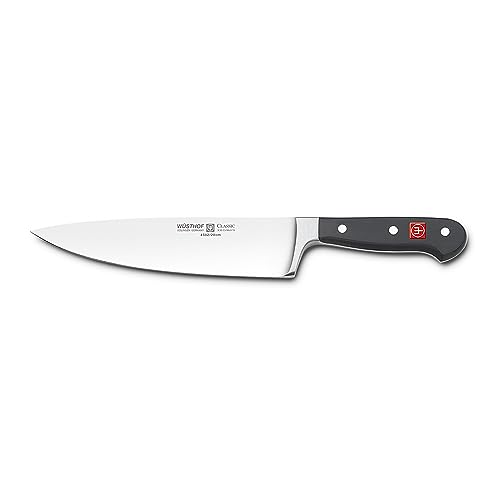
Wüsthof
Forged single-piece construction provides outstanding balance and heft

MAC
Exceptional out-of-box sharpness that outperforms most knives in its price range