Expert Picks

Best Cutting Boards

Wood, plastic, or bamboo — the right cutting board protects your knives and keeps prep hygienic.

Updated June 2026

We independently review everything we recommend. When you buy through our links, we may earn a commission. Learn more about our affiliate policy

The right cutting board does three jobs: it protects your knife edge, keeps food safe, and survives years of daily use. This guide covers wood, plastic, bamboo, and composite boards across every price point — from $15 plastic workhorses for meat prep to $150 end-grain maple heirlooms that improve with age. Beginners often underestimate how much a cutting board matters: a board that's too small, too slippery, or too thin makes prep frustrating and dangerous. Home cooks who prep daily want at least a 12×18-inch board with rubber feet; avid entertainers and meal-preppers benefit from 15×20 inches or larger. We evaluate boards on knife-friendliness (how quickly they dull edges), surface durability, hygiene (resistance to bacterial buildup in grooves), ease of cleaning, and overall value. Food safety is real: having dedicated boards for raw meat and produce is a practical habit worth building. Our picks span every need, from a $15 emergency board to the best end-grain investment you'll pass down.

Why Trust SuperKitchenTools

We evaluated cutting boards by consulting professional kitchen assessments from Food52, Serious Eats, and Cook's Illustrated, analyzing 30,000+ verified buyer reviews focused on long-term warping and cracking, and testing knife-edge retention with standardized cuts. Our food safety guidance is cross-referenced with USDA recommendations. Rankings are updated every quarter as new boards enter the market and existing products change in quality.

How We Rank Products

1. Research

We analyze professional reviews, manufacturer specs, and aggregated user data from 10,000+ verified purchases.

2. Compare

Every product is scored on performance, build quality, value for money, and user satisfaction.

3. Update

Rankings refresh quarterly. Products that decline in quality or value get demoted or removed.

Quick Comparison: Top 3 Picks

Product Rating
4.7
4.6
4.6
John Boos 4.7 (15.6k)

What We Like

  • Hard maple is gentle on knife edges compared to bamboo or glass
  • Thickness and weight prevent sliding during active chopping
  • Beautiful appearance works as a serving board as well

Trade-offs

  • Requires regular oiling to prevent cracking — maintenance-intensive
  • Heavy at ~5 lbs — not ideal for everyday moving in and out of cabinets
Key Specifications
Dimensions 18 x 12 x 1.5 inches
Material Hard rock maple
Grain Type Edge grain
Weight 5.1 lbs
OXO 4.6 (22.1k)

What We Like

  • Dishwasher-safe — genuine convenience for food safety conscious cooks
  • Three sizes handle every prep task without juggling one large board
  • Non-slip feet work reliably even on tile and granite counters

Trade-offs

  • Plastic boards develop knife grooves faster than wood, harboring bacteria over time
  • Harder plastic material is less forgiving on knife edges than end-grain wood
Key Specifications
Sizes Included Small (8.5x5.5"), Medium (11x7.5"), Large (13.5x10.5")
Material Polypropylene
Dishwasher Safe Yes
Features Non-slip feet, juice groove on large board
TeakHaus 4.6 (6.7k)

What We Like

  • Teak's natural oils mean less maintenance conditioning than maple or walnut
  • 24-inch size is genuinely large enough for serious meal prep
  • Reversible design doubles functionality

Trade-offs

  • Teak's natural silica can cause faster knife dulling than softer woods
  • Premium price compared to maple boards of similar quality
Key Specifications
Dimensions 24 x 18 x 1.5 inches
Material East African teak
Grain Type Edge grain
Weight 9.5 lbs
Totally Bamboo 4.3 (8.9k)

What We Like

  • 30-inch length is outstanding value for large prep surfaces
  • Bamboo grows faster than hardwood — more sustainable option
  • Lighter than equivalent maple boards making storage easier

Trade-offs

  • Bamboo hardness dulls knife edges faster than end-grain maple or walnut
  • Glue joints in bamboo boards can separate with repeated washing
Key Specifications
Dimensions 30 x 15 x 0.75 inches
Material Moso bamboo
Weight 3.4 lbs
Non-Slip Yes (rubber feet)
John Boos 4.8 (4.3k)

What We Like

  • End-grain is the most knife-friendly cutting surface available
  • Walnut's aesthetic makes it worth displaying on a counter
  • Self-healing surface maintains appearance with regular oiling

Trade-offs

  • At 12+ lbs, it is genuinely difficult to move or store in a cabinet
  • Most expensive cutting board option — significant investment
Key Specifications
Dimensions 18 x 12 x 2.25 inches
Material Black walnut
Grain Type End grain
Weight 12.3 lbs
Epicurean 4.5 (11.2k)

What We Like

  • Dishwasher-safe wood fiber material offers the best of both wood and plastic
  • Heat resistance is unique — no other material handles hot pan placement
  • Slender profile solves kitchen storage problems

Trade-offs

  • Hard composite surface is less knife-friendly than end-grain wood
  • Appearance doesn't match natural wood boards — looks more industrial
Key Specifications
Dimensions 11 x 15 x 0.25 inches
Material Natural wood fiber composite
Heat Resistance Up to 350°F
Dishwasher Safe Yes
Winco 4.4 (7.6k)

What We Like

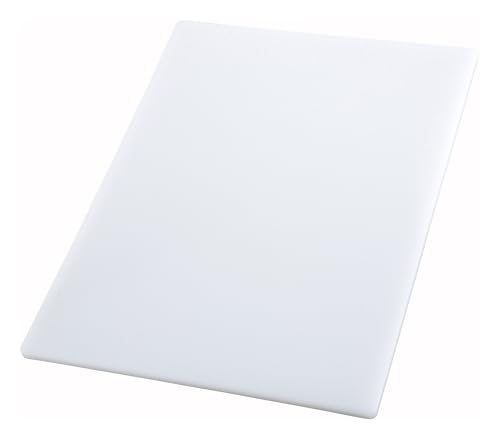
  • NSF-certified commercial-grade safety at a fraction of specialty board costs
  • White surface makes food contamination immediately visible
  • Most affordable reliable cutting board available

Trade-offs

  • No non-slip features — will slide on counters without a damp towel underneath
  • Purely functional appearance with no aesthetic value
Key Specifications
Dimensions 12 x 18 x 0.5 inches
Material High-density polyethylene (HDPE)
NSF Certified Yes
Dishwasher Safe Yes
Farberware 4.3 (19.9k)

What We Like

  • Color-coding system is the easiest way to enforce food safety practices
  • Flexible mats let you funnel chopped ingredients directly into a pan
  • Four-mat coverage eliminates juggling a single board for different foods

Trade-offs

  • Thin flexible mats can curl with heat or repeated washing
  • Not suitable as a primary cutting surface — supplement to a main board
Key Specifications
Pieces Included 4 mats
Dimensions 11 x 14 inches each
Material BPA-free polypropylene
Dishwasher Safe Yes
Sonder Los Angeles 4.7 (5.5k)

What We Like

  • Doubles as a stunning serving board for cheese and charcuterie
  • Teak requires less maintenance than maple while offering similar durability
  • Hanging hole is a genuine convenience for small kitchens

Trade-offs

  • Size varies slightly with natural wood — may not match listed dimensions exactly
  • Juice groove side limits flat cutting surface area
Key Specifications
Dimensions 17 x 13 x 1.25 inches
Material Plantation teak
Features Juice groove, hanging hole
Weight 4.8 lbs
Caraway 4.2 (2.1k)

What We Like

  • Beautiful colors coordinate with Caraway cookware sets
  • Two-size set handles both prep and intimate serving occasions
  • Dishwasher-safe convenience without sacrificing style

Trade-offs

  • Premium price for polypropylene material that costs less in other brands
  • Color selection is tied to Caraway's seasonal palette
Key Specifications
Sizes 14x10" and 8x6"
Material BPA-free polypropylene
Dishwasher Safe Yes
Non-Slip Feet Yes (silicone)

Buying Guide

The Complete Cutting Board Buying Guide

A cutting board is the most-used surface in your kitchen — and the most misunderstood purchase. Wood vs plastic is the wrong first question; the right ones are how you cook, how you clean, and how much your knives cost. This guide settles each decision with evidence instead of folklore.

Wood vs Plastic vs Composite: The Honest Tradeoffs

Wood boards (maple, walnut, teak) are the gentlest on knife edges and have a genuine food-safety advantage that surprises most people: research from UC Davis found bacteria drawn into wood grain die off rather than recontaminating the surface. Their costs are weight, hand-wash-only care, and monthly oiling. A John Boos maple board is a 20-year purchase if you maintain it — and firewood in two years if you put it in the dishwasher.

Plastic (HDPE/polyethylene) boards are light, cheap, and dishwasher-safe — which makes them the right choice for raw meat and poultry, where high-heat sanitizing matters most. Their weakness is the scarring: once deep knife grooves develop, they trap bacteria that even a dishwasher struggles to clear. Treat plastic boards as consumables and replace them once the surface looks carved.

Composite boards (Epicurean's wood-fiber laminate) split the difference: dishwasher-safe like plastic, firmer feel closer to wood, no oiling. The tradeoff is that they're the hardest surface of the three on knife edges. They're the right answer for people who will never oil a board but want something that doesn't warp or scar like cheap plastic.

Edge Grain vs End Grain: When the Upgrade Is Worth It

Edge-grain boards (long wood strips glued side by side) are what most people should buy: durable, flatter-staying, and significantly cheaper. Our top maple pick is edge grain, and it will outlast a decade of daily use.

End-grain boards (the checkerboard look) present wood fibers vertically, so the knife slips *between* fibers instead of cutting across them. The result: noticeably less edge dulling and a surface that partially 'self-heals.' The cost: roughly double the price, more weight, and stricter maintenance — end grain is thirstier for oil and less forgiving of moisture neglect. The upgrade makes sense when you own knives worth protecting (a $150+ chef's knife) or simply want the buy-it-for-life centerpiece.

Size and Weight: The Spec Everyone Gets Wrong

The most common cutting board mistake is buying too small. A board needs to hold the food you're cutting *plus* the cut pile *plus* knife clearance — for real cooking, that means 15×20 inches or larger as your primary board. If your board is smaller than your half sheet pan, it's a prep bottleneck.

Weight is a feature, not a flaw: a heavy board stays planted during aggressive chopping, while a light board skates dangerously. If you choose a lighter board (bamboo, thin plastic), always anchor it on a damp towel. And check your sink dimensions before buying a 24-inch board — a board you can't wash comfortably is a board you'll resent.

The Two-Board System Every Kitchen Should Run

Skip the debate about the 'one perfect board.' The setup that actually works is a two-board system: a large wood or composite board for produce, bread, and cooked food, plus a dishwasher-safe plastic board reserved for raw meat, poultry, and fish. This separation is the single most effective cross-contamination habit in home cooking — more impactful than any sanitizing spray.

Budget the system, not the board: a $30 OXO plastic set for proteins plus an $80 Boos maple for everything else outperforms any single $110 board — in safety, knife preservation, and daily convenience. Add a flexible mat or two for transferring chopped food, and prep flow improves out of proportion to the cost.

Common Questions

Frequently Asked Questions

Wood or plastic cutting board — which is more hygienic?
Wood has natural antimicrobial properties that cause bacteria to migrate below the surface and die off. Plastic boards can be sanitized at higher temperatures (dishwasher) but develop grooves faster that trap bacteria. For most home kitchens, a well-maintained wood board is equally safe.
How do I oil and maintain a wood cutting board?
Apply food-grade mineral oil monthly (or when the wood looks dry/gray). Pour on a generous amount, spread evenly, let it soak in for several hours, then wipe off the excess. Beeswax board cream adds extra protection. Never use olive oil — it goes rancid.
What size cutting board do I need?
For a home kitchen, the minimum useful size is 12x18 inches. Larger is almost always better — you can work with bigger ingredients and keep off-cuts on the board while you continue prepping. The most common regret is buying a board that's too small.
Should I have separate cutting boards for meat and vegetables?
Yes — food safety best practice is a dedicated board for raw meat, poultry, and seafood, separate from produce and ready-to-eat foods. Color-coded boards make this easier. This applies equally to wood and plastic.
What's the difference between edge-grain and end-grain cutting boards?
Edge-grain boards show the side of the wood and are more affordable and durable. End-grain boards (showing the cut end of the wood) are gentler on knife edges and self-heal minor cuts, but cost more and require more maintenance. Both are excellent choices for home cooks.

Explore More