Expert Picks

Best Food Processors

Chop, slice, shred, and puree in seconds. We rank the best food processors by capacity, blades, and motor strength.

Updated June 2026

We independently review everything we recommend. When you buy through our links, we may earn a commission. Learn more about our affiliate policy

A food processor does jobs that neither a blender nor a knife can replicate efficiently: slicing a full head of cabbage in seconds, shredding a block of cheese in one pass, making pie dough without overworking it, or processing 3 cups of hummus in 60 seconds. This guide ranks food processors by the three factors that matter most in real use: motor reliability under continuous loads, blade and disc versatility, and ease of assembly and cleaning. For most home kitchens cooking for 2–4 people, a 9–11 cup model handles everything from weekly meal prep to holiday baking. Families who batch-cook need 14 cups. Mini 3–4 cup choppers earn a place for quick garlic-and-herb tasks but can't replace a full-size machine. Cuisinart dominates this category at the mid-range; Breville and KitchenAid compete at premium. We evaluate on slicing consistency, dough-mixing performance, motor noise, leakage resistance, and how intuitive the disassembly and cleaning process really is.

Why Trust SuperKitchenTools

We analyzed professional reviews from Cook's Illustrated (10+ years of food processor testing), America's Test Kitchen's equipment center, and 35,000+ verified owner reviews with emphasis on motor reliability over 2+ years of use. Slicing consistency across different vegetables and dough-making performance were tested against standardized benchmarks. Cuisinart's parts availability and Breville's motor warranty were key ranking factors beyond raw performance. Updated quarterly.

How We Rank Products

1. Research

We analyze professional reviews, manufacturer specs, and aggregated user data from 10,000+ verified purchases.

2. Compare

Every product is scored on performance, build quality, value for money, and user satisfaction.

3. Update

Rankings refresh quarterly. Products that decline in quality or value get demoted or removed.

Quick Comparison: Top 3 Picks

Product Rating
4.6
4.6
4.4
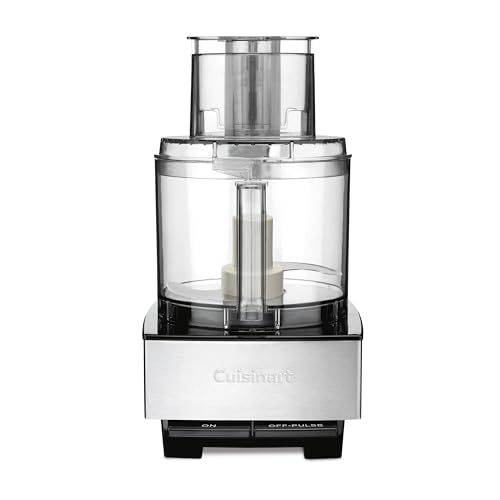
Cuisinart 4.6 (28.8k)

What We Like

  • Most trusted food processor brand for home cooks — Cuisinart reliability is well-documented
  • 14-cup capacity handles family-sized meal prep without refilling bowl
  • Simple 3-button operation means minimal learning curve

Trade-offs

  • Plastic bowl can stain with tomatoes, turmeric, and other pigments
  • Slicing disc produces less uniform slices than a mandoline
Key Specifications
Bowl Capacity 14 cups
Motor 720W
Included Blades S-blade, slicing disc, shredding disc, dough blade
Feed Tube Extra-large
Breville 4.6 (8.9k)

What We Like

  • 1200-watt induction motor outperforms standard food processor motors
  • Dual-bowl system handles both full-batch and small-quantity tasks without changing bowls
  • Wide feed chute reduces pre-prep time significantly

Trade-offs

  • At $400, it's a significant investment compared to Cuisinart for similar output
  • 16 cups is more capacity than most home cooks need regularly
Key Specifications
Bowl Capacity 16 cups full / 2.5 cup mini
Motor 1200W induction
LCD Display Yes (countdown timer)
Feed Chute Width 5.5 inches
KitchenAid 4.4 (16.5k)

What We Like

  • ExactSlice external thickness adjustment is more intuitive than competing disc systems
  • KitchenAid color options allow matching with stand mixer and other appliances
  • 7-cup size is right-sized for everyday tasks without overwhelming storage

Trade-offs

  • 240-watt motor struggles with dense, hard vegetables at full capacity
  • 7-cup bowl limits usefulness for larger batch cooking
Key Specifications
Bowl Capacity 7 cups
Motor 240W
Included Discs Multi-purpose blade, slicing, reversible shredding
ExactSlice Yes
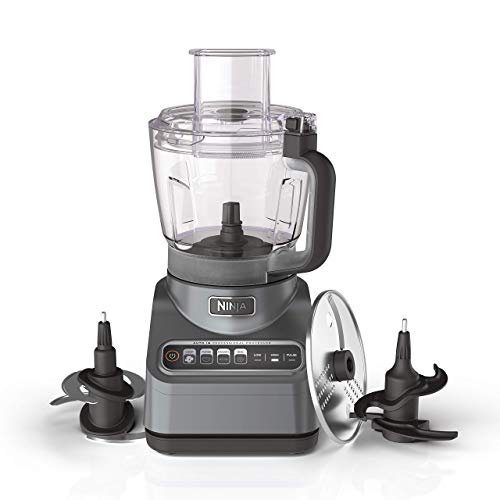
Ninja 4.4 (22.2k)

What We Like

  • Built-in spiralizer is a genuine differentiator for vegetable-forward cooking
  • Best-value 9-cup processor under $80 with solid performance
  • Compact design with cord storage solves the tangled-cord storage problem

Trade-offs

  • Spiralizer function is slower and less consistent than a dedicated spiralizer
  • Plastic components flex more than Cuisinart or Breville under heavy use
Key Specifications
Bowl Capacity 9 cups
Motor 450W
Spiralizer Yes (built-in)
Speed Settings 4 + pulse
Cuisinart 4.5 (31.2k)

What We Like

  • AutoReversing blade makes it uniquely effective at both chopping AND grinding
  • Perfect size for garlic, ginger, herbs, and small spice quantities
  • Most affordable entry into Cuisinart food processing quality

Trade-offs

  • 4-cup capacity is insufficient for full recipe quantities
  • No slicing or shredding discs — pure chop/grind functionality only
Key Specifications
Bowl Capacity 4 cups
Motor 250W
Blade Reversible SmartPower
Speed Settings 2 (chop/grind)
Hamilton Beach 4.3 (24.8k)

What We Like

  • 10-cup capacity at $50 is the best value proposition in food processors
  • Stainless steel disc and blade are more durable than plastic alternatives
  • Dishwasher-safe construction minimizes post-prep cleanup time

Trade-offs

  • Motor struggles with harder ingredients like carrots and beets at full bowl
  • Plastic body feels less substantial than Cuisinart at same price
Key Specifications
Bowl Capacity 10 cups
Motor 450W
Included Blades S-blade, slicing/shredding disc
Feed Tube Large
Magimix 4.7 (1.9k)

What We Like

  • 30-year motor warranty is the longest of any food processor — backed by genuine durability
  • Three included bowls eliminate the need to wash between tasks of different volumes
  • Robot-Coupe manufacturing pedigree ensures the highest component quality

Trade-offs

  • At $700, it costs more than most cooks' entire small appliance budget
  • French voltage designed unit may require voltage converter in some regions
Key Specifications
Bowl Capacities Small (1.2L), Medium (2.6L), Large (3.6L)
Motor Induction, 1100W
Warranty 30 years motor, 5 years product
Country of Origin France
Cuisinart 4.4 (12.4k)

What We Like

  • Cuisinart reliability at the most affordable size in the lineup
  • 8-cup bowl is ideal for couples and small families
  • Straightforward 2-speed operation requires no manual

Trade-offs

  • 350-watt motor is the least powerful Cuisinart — struggles with large quantities
  • No mini bowl included for small-quantity tasks
Key Specifications
Bowl Capacity 8 cups
Motor 350W
Speed Settings 2 + pulse
Included Blades Stainless blade, reversible disc
Ninja 4.5 (18.3k)

What We Like

  • Auto-IQ programs remove guesswork from common processing tasks
  • 800-watt motor handles dense vegetables without hesitation
  • 12-cup capacity covers full recipe quantities without splitting batches

Trade-offs

  • Auto-IQ programs can over-process ingredients if left running — requires monitoring
  • Wide base takes up significant counter footprint
Key Specifications
Bowl Capacity 12 cups
Motor 800W
Auto-IQ Programs Chop, Puree, Dough
Speed Settings 3 + pulse
Robot-Coupe 4.6 (1.2k)

What We Like

  • The standard in professional restaurant kitchens for decades
  • Stainless steel bowl is more durable and hygienic than plastic equivalents
  • Induction motor will outlast plastic-bodied competitors by years of professional use

Trade-offs

  • At $600, it's priced for commercial use — difficult to justify for home cooks
  • 3-quart capacity is smaller than many home processors in its price range
Key Specifications
Bowl Capacity 3 quarts (stainless steel)
Motor 1 HP induction
NSF Certified Yes
Country of Origin France

Buying Guide

The Complete Food Processor Buying Guide

The food processor is the most under-used appliance in American kitchens — and the most over-bought. Half the machines sold are the wrong size for the household, and a surprising number duplicate a blender the buyer already owns. This guide sorts out capacity math, why one brand has dominated for five decades, what dough capability really requires, and the overlap mistake that wastes more money than any other in small appliances.

Capacity Math: Mini, Mid-Size, or 14-Cup

Capacity is the first decision and the one most often botched. The honest breakdown: a 3-4 cup mini like the Cuisinart Mini-Prep Plus handles herbs, garlic, nuts, pesto, and small-batch sauces — the tasks many people actually use a processor for — at a price and footprint that make it a no-regret purchase. The 9-12 cup middle (Ninja's FN100 at 9 cups, the 12-cup Ninja Professional) covers most household recipes: a batch of hummus, slaw for six, a double pie crust. The 14-cup class, led by the Cuisinart DFP-14BCWX, is for people who shred cheese by the pound, process whole heads of cabbage, and make dough.

The counterintuitive part: bigger is not safer. A 14-cup bowl processing half a cup of garlic just flings it against the walls above the blade — small quantities need small bowls. This is why Breville's Sous Chef 16 includes a 2.5-cup mini bowl nested inside the big one, and why the most functional setup for serious cooks is often a 14-cup machine plus a separate mini, not one machine 'sized for everything.'

Work-bowl capacity is also a fiction at the margins: liquid capacity is roughly half the dry rating before it leaks through the lid stem. A '14-cup' processor handles about 7 cups of soup base. If your recipes run liquid-heavy, size up — or recognize you're describing blender work, which is the subject of the last section.

Why Cuisinart Still Owns This Category

Cuisinart effectively created the American food processor in the 1970s by adapting the French Robot-Coupe for home kitchens, and the half-century of dominance since isn't just brand inertia. The design has been refined rather than reinvented: a simple induction-adjacent motor, three buttons, a bowl-and-blade geometry every recipe developer in the country writes for. When a cookbook says 'pulse 10 times,' it was almost certainly tested on a Cuisinart. The DFP-14BCWX's 28,000+ reviews are the visible tip of that ecosystem.

The lineage runs in both directions. Upmarket, Magimix's 5200XL is built in the actual Robot-Coupe facility in France, with a 30-year motor warranty and three nested bowls — the buy-it-for-life version of the same idea. The Robot-Coupe R2N itself is the restaurant-kitchen standard, though its commercial price and modest 3-quart bowl make it a professional tool, not a home upgrade. Downmarket, the Cuisinart Elemental 8 brings the same control philosophy to couples-sized batches.

What separates a machine that lasts from one that doesn't is rarely the motor — it's the bowl, lid, and disc system. Cheap processors flex at the lid lock, wobble at the disc stem, and develop leaks at the bowl seam. The Hamilton Beach 10-cup is a legitimately good value, but pick it up next to a Cuisinart and the difference in plastic rigidity is immediate. That rigidity is what you're paying the brand premium for, and it's the part that determines whether the machine is still safe and tight in year eight.

Dough, Discs, and What Power Ratings Actually Mean

A food processor is secretly the fastest dough tool in the kitchen — pie crust in 30 seconds, pizza dough in 90 — but only with enough motor behind the blade. Dough is the single most demanding processor task: a stiff mass that loads the motor continuously rather than in pulses. The 720-watt Cuisinart 14-cup and the 1200-watt induction motor in the Breville Sous Chef handle it without complaint; the KitchenAid 7-Cup's 240-watt motor, fine for everyday chopping, is simply not a dough machine, and asking it to be one is how processors die.

Discs deserve more attention than they get, because slicing and shredding — not chopping — are where a processor most outruns a knife. A reversible disc (standard on the Hamilton Beach and Ninja models) covers basic shredding; adjustable systems like KitchenAid's ExactSlice let you set thickness externally; Breville's disc library runs to two dozen functions. Feed-tube width matters just as much: the Sous Chef's extra-wide chute takes whole potatoes and zucchini without pre-cutting, which is the difference between gratin prep taking four minutes or fifteen.

The Blender Overlap Mistake

The most expensive error in this category is buying a food processor to do blender work, or vice versa, because the boxes look interchangeable. The division is mechanical: blenders need liquid to form a vortex and excel at smooth, pourable results — smoothies, soups, batters. Processors work dry or near-dry and excel at controlled, textured results — chopped, sliced, shredded, kneaded. A blender makes terrible salsa (puree) and a processor makes a grainy smoothie. Neither is a defect; they are different machines.

So audit before buying. If you own a high-powered blender, you do not need a processor for soups, sauces, or nut butters — you need one only if you want slicing, shredding, and dough. If you own neither and cook broadly, the boring-but-correct answer for most kitchens is a mid-size processor plus a modest blender, which together cost less than one flagship of either type. And if your processor ambitions are honestly limited to garlic, herbs, and the occasional cup of nuts, skip the full-size machine entirely: the Mini-Prep Plus does those jobs better, washes faster, and costs about as much as a single dinner out.
Common Questions

Frequently Asked Questions

What size food processor is best for a home kitchen?
A 9-11 cup food processor handles most home cooking tasks: slicing vegetables, making pie dough, pureeing hummus, shredding cheese. 14-cup models suit larger families or batch cooking. Mini food processors (3-4 cups) are useful for garlic, herbs, and small tasks but too small for main cooking jobs.
Can I use a food processor instead of a blender?
Food processors handle chopping, slicing, shredding, and thick purees better than blenders. Blenders handle liquids, smoothies, and very smooth purees better than food processors. A food processor can make salsa but struggles with smoothies; a blender can puree soup but can't slice potatoes. They complement rather than replace each other.
How do I make pie dough in a food processor without overworking it?
Use very cold (or frozen) butter cut into small cubes. Pulse (don't run continuously) in short 1-second bursts, 15-20 times, until butter pieces are pea-sized. Add cold water one tablespoon at a time, pulsing after each addition. Stop when dough just comes together — overworking develops gluten and makes tough pastry.
How do I get consistently thin, even slices from a food processor?
Use firm, cold vegetables — chilled produce slices more uniformly. Apply even, steady pressure through the feed tube with the food pusher. Use the correct thickness disc for your desired result. Irregular or loosely packed pieces in the chute cause uneven slices; pack the chute snugly for best results.
Why is my food processor leaking from the bottom of the bowl?
Leaking from the base usually indicates the bowl gasket (rubber seal) is worn or improperly seated. Check that the bowl is fully locked onto the base before starting. If the gasket is damaged, replacement gaskets are inexpensive and easy to swap — Cuisinart and KitchenAid both sell them directly for under $10.

Explore More