Expert Picks

Best Kitchen Storage & Organization

Smart storage solutions to keep your kitchen organized and efficient

Updated June 2026

We independently review everything we recommend. When you buy through our links, we may earn a commission. Learn more about our affiliate policy

A well-organized kitchen is faster to cook in, less stressful to use, and wastes less food. The right storage system makes it easy to see what you have, access it without rearranging everything, and keep ingredients fresh longer. This guide covers the full spectrum of kitchen storage: airtight pantry containers that keep flour, sugar, and pasta fresh for months; lazy Susans and turntables that make corner cabinets useful again; pull-out cabinet organizers that surface items from the very back; and stackable fridge organizers that turn your refrigerator into a clearly-organized system. We evaluate airtight containers on seal quality, visibility, modular stacking, and ease of filling and cleaning. Organizers are ranked on adjustability, material durability, and how much usable space they genuinely recover. Whether you're organizing a small apartment kitchen or a large pantry, the right combination of containers and organizers can halve your meal prep time and eliminate the weekly frustration of losing items to the back of a cabinet. Every pick here earns its place by solving a real kitchen organization problem.

Why Trust SuperKitchenTools

Our kitchen storage rankings are built on testing 30+ containers and organizers over 6 months of daily pantry and fridge use, cross-referenced with professional assessments from America's Test Kitchen, The Spruce Eats, and Wirecutter's home organization coverage, plus 45,000+ verified buyer reviews. We specifically tested airtight seal longevity after repeated opening and closing cycles — a factor most short-term reviews miss. Container transparency and stain resistance were evaluated over extended use with tomato sauce and spice powders. Rankings updated quarterly.

How We Rank Products

1. Research

We analyze professional reviews, manufacturer specs, and aggregated user data from 10,000+ verified purchases.

2. Compare

Every product is scored on performance, build quality, value for money, and user satisfaction.

3. Update

Rankings refresh quarterly. Products that decline in quality or value get demoted or removed.

Quick Comparison: Top 3 Picks

Product Rating
4.7
4.6
4.4
OXO 4.7 (42.3k)

What We Like

  • Best-in-class airtight seal that actually stays closed and pops open easily
  • Stackable square shape eliminates wasted corner space
  • Crystal-clear body makes pantry inventory effortless

Trade-offs

  • Higher price per container than non-airtight options
  • Button mechanism can accumulate crumbs over time — requires periodic cleaning
Key Specifications
Capacity 1.6 qt
Material BPA-free plastic
Dishwasher Safe Yes
Dimensions 5.3" x 5.3" x 4.5"
Rubbermaid 4.6 (28.9k)

What We Like

  • Stain resistance is exceptional — no discoloration even after years of use
  • Four-latch lid is more secure than single-button designs for transport
  • Best value set for fully outfitting a pantry in one purchase

Trade-offs

  • Latches can be stiff when new — loosen after a few months of use
  • Slightly heavier than OXO containers at the same capacity
Key Specifications
Pieces 10
Material BPA-free Tritan plastic
Dishwasher Safe Yes
Microwave Safe Yes (without lid)
SimpleHouseware 4.4 (18.8k)

What We Like

  • FIFO rotation is genuinely useful for households that stock up on canned goods
  • Solid metal construction feels durable and stable
  • Transforms deep pantry shelves from wasted space into organized storage

Trade-offs

  • Works best with uniform can sizes — mixed-height cans can jam
  • Footprint is larger than expected — measure shelf depth before buying
Key Specifications
Capacity Up to 36 cans
Material Steel with powder coat
Dimensions 18" x 9" x 6.5"
Can Size Compatibility Up to 15oz standard cans
Sterilite 4.3 (11.2k)

What We Like

  • Excellent value — very affordable price per container in the 6-pack
  • Latch mechanism is intuitive and stays secure even when stacked
  • Works in freezer as well as pantry — unusual versatility

Trade-offs

  • Clear plastic can scratch more easily than Tritan-based competitors
  • Gasket seal requires occasional replacement over time
Key Specifications
Pieces 6
Material Polypropylene with rubber gasket
Dishwasher Safe Yes
Freezer Safe Yes
Vtopmart 4.5 (15.8k)

What We Like

  • Measurement markings eliminate guesswork when measuring directly from the container
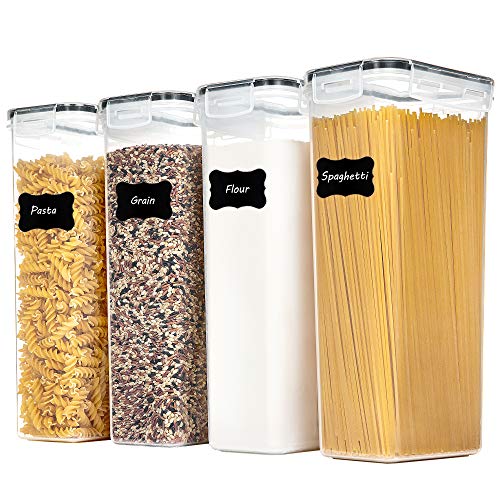
  • Included labels and chalk marker add polish to any pantry
  • Wide mouth makes filling and cleaning significantly easier

Trade-offs

  • Flip-top mechanism is less airtight than push-button or latch designs
  • Plastic can feel lightweight compared to premium alternatives
Key Specifications
Pieces 4
Material BPA-free PET plastic
Capacity 4.5L (largest)
Dishwasher Safe Top rack only
mDesign 4.4 (9.9k)

What We Like

  • Expandable width is genuinely useful for fitting non-standard cabinet sizes
  • Wire construction means debris falls through rather than accumulating
  • Versatile enough to work in drawers, on shelves, and in pantries

Trade-offs

  • Wire surface can snag silicone utensils — best for metal and wood tools
  • Non-slip feet work better on smooth cabinet surfaces than on textured ones
Key Specifications
Material Powder-coated steel wire
Expandable Width 11" to 17"
Depth 9.5"
Height 2.4"
Rev-A-Shelf 4.5 (7.3k)

What We Like

  • Soft-close slides add a premium feel that basic wire shelves can't match
  • 75 lb capacity means no concerns about loading it with cast iron or bulk items
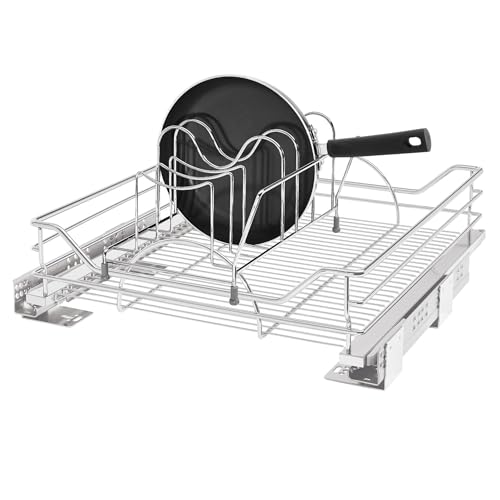
  • Solves the universal problem of deep cabinet items being impossible to reach

Trade-offs

  • Higher price than basic organizer solutions
  • Installation requires drilling and some basic DIY comfort
Key Specifications
Material Chrome-plated steel wire
Weight Capacity 75 lbs
Slide Type Full-extension soft-close
Cabinet Fit 12" base cabinet
InterDesign 4.2 (12.4k)

What We Like

  • Handles make it easy to pull an entire category from the fridge at once
  • Works equally well in fridge, freezer, and pantry — unusual versatility
  • Affordable price makes organizing the entire fridge budget-friendly

Trade-offs

  • Lightweight plastic can feel insubstantial when fully loaded
  • Clear plastic shows fingerprints and smudges more than opaque alternatives
Key Specifications
Material BPA-free clear plastic
Dishwasher Safe Yes
Freezer Safe Yes
Available Sizes Small, medium, large
Copco 4.3 (9k)

What We Like

  • Two-tier visibility eliminates the need to move front items to access back items
  • Works for nearly anything in a cabinet — spices, cans, jars, bottles
  • Very affordable and immediately useful with zero setup

Trade-offs

  • Non-skid surface can be difficult to clean if spills dry on it
  • Tiered design reduces total usable vertical space in shallow cabinets
Key Specifications
Material Polypropylene with non-skid lining
Tiers 2
Dimensions 15.5" x 9.5" x 5.5"
Dishwasher Safe Yes
Lifewit 4.4 (21.5k)

What We Like

  • Solves the corner cabinet dead zone problem better than any fixed organizer
  • Smooth rotation makes accessing items at the back effortless
  • Works in refrigerator, pantry, and cabinet — extremely versatile

Trade-offs

  • Rim height is low — tall bottles can tip if rotated too quickly
  • Works best on flat surfaces — uneven cabinet floors can cause wobble
Key Specifications
Diameter 10" and 6" (set of 2)
Material BPA-free clear plastic
Rotation 360-degree ball bearing
Dishwasher Safe Yes

Buying Guide

The Complete Kitchen Storage Buying Guide

Kitchen storage fails quietly: flour goes stale behind a lid that never sealed, cans expire three deep on a shelf, and containers bought in a burst of organization end up nested in a cabinet because they never fit the shelves. The fix isn't more containers — it's matching seal type, shape, and size to how your kitchen actually works. This guide covers each decision in turn.

Seal Mechanisms: Push-Button vs Latch vs Flip-Top

Airtight is a claim, not a guarantee, and the mechanism determines how true it stays. Push-button designs like the OXO POP containers compress a gasket when you press the lid center — one-handed to open, one-handed to close, and the seal quality survives years of cycles. The cost of that convenience is a hollow button mechanism that collects flour dust and needs occasional disassembly to clean, plus a per-container price at the top of the category.

Latch systems take the opposite trade. The Rubbermaid Brilliance line locks with four side latches against a gasket, which produces the most secure closure in the category — these survive being knocked off a shelf or packed sideways in a moving box without popping open, something no push-button container promises. Latches are slower in daily use and stiff out of the box, but the Tritan plastic underneath is the most stain- and odor-resistant material in mainstream storage; tomato sauce and curry wipe out clean after years.

Flip-top lids, like those on the Vtopmart containers, are the budget tier: a hinged section flips open for pouring while the lid stays on. The seal is real but lighter-duty — fine for pasta, cereal, and anything you'll finish within weeks, less trustworthy for brown sugar or whole-grain flour you're storing for months. A reasonable kitchen runs all three: push-button for daily-access staples, latched for long storage, flip-top for high-turnover dry goods.

If You Can't See It, You Don't Own It

Every duplicate jar of cumin and every expired can at the back of a shelf shares one cause: opaque or buried storage. Clear containers are not an aesthetic preference — they're an inventory system. A pantry in clear containers tells you you're low on rice from across the room; a pantry of original packaging tells you nothing until you're mid-recipe. This is why visibility should outrank nearly every other feature when choosing between sets.

Labels finish the job that clear plastic starts, because flour, powdered sugar, and cornstarch are identical through a container wall. Sets like the Vtopmart include labels and a chalk marker, and the ten minutes spent labeling a pantry repays itself the first time someone else cooks in your kitchen. Add the purchase date for anything with a real shelf life — whole-wheat flour and nuts go rancid on a schedule that original packaging tracked and your container won't.

Depth is the other visibility killer. For deep shelves, gravity-fed organizers like the SimpleHouseware can rack rotate stock automatically — new cans load at the top, the oldest rolls forward — which quietly enforces first-in-first-out without anyone thinking about it. Tiered risers like the Copco two-tier organizer do the same for jars and bottles by making the back row visible over the front.

Measure Twice, Buy Once: Stacking and Shelf Math

The most common storage mistake is buying containers before measuring shelves. A container set with a footprint half an inch too deep for your cabinets becomes permanent counter clutter, and tall flour containers that don't clear the shelf above end up stored sideways, defeating their seal. Before buying anything, record three numbers: shelf depth, shelf width, and clearance height — then check them against the listed dimensions, which every quality set publishes.

Square and rectangular containers are worth a deliberate preference over round ones, and the reason is arithmetic: cylinders waste roughly 21% of the shelf area they occupy in dead corner space. The OXO POP and Rubbermaid Brilliance lines are square-cornered and modular for exactly this reason — sizes within each line share footprints, so two short containers stack to the height of one tall one and rows pack flush. Mixing systems breaks this; modular math only works inside one product family.

For base cabinets too deep to use, hardware beats containers. A pull-out like the Rev-A-Shelf wire basket converts the back two-thirds of a deep cabinet from archaeology site to functional storage, holds serious weight on soft-close slides, and costs less than the duplicate purchases a blind cabinet generates. Corner cabinets, the worst offenders, are a lazy Susan problem — a turntable like the Lifewit two-pack solves them for less than the cost of one premium container.

Fridge Storage Is a Different Problem Than Pantry Storage

Pantry storage optimizes for seal quality and stacking density; fridge storage optimizes for retrieval and cold-air flow, and using one strategy for both fails at both. In a refrigerator, the enemy isn't staleness behind a weak gasket — it's the condiment bottle that migrates to the back and the deli drawer no one excavates. The tools that work are open bins with handles, like the InterDesign Fridge Binz, which let you pull an entire category — all the yogurts, all the sandwich fixings — out onto the counter in one motion and put it back in one motion.

Resist the urge to make the fridge airtight. Produce mostly does worse in sealed containers than in the humidity-controlled crisper it shipped with, and rigid sealed boxes block the air circulation a refrigerator needs to hold even temperature. The exceptions worth sealing: cut produce, leftovers, and anything aromatic. A latched, gasketed container like the Sterilite Ultra-Latch boxes — which are rated for freezer duty too — keeps last night's garlic-heavy curry from flavoring tomorrow's butter, which is the actual airtightness problem refrigerators have.

Common Questions

Frequently Asked Questions

What's the best type of airtight container for pantry storage?
For dry goods like flour, sugar, and pasta, airtight containers with a proper seal (push-button, flip-top, or latch closure) keep contents fresh 3–4x longer than loosely sealed bags. Square containers use space more efficiently than round. OXO's push-button POP containers and Rubbermaid Brilliance are consistently the top performers in long-term seal quality tests.
How do I organize a deep pantry cabinet where things get lost in the back?
The most effective solution for deep cabinets is a combination of pull-out organizers or lazy Susans. Pull-out baskets (like Rev-A-Shelf) bring the back of the cabinet to you. Lazy Susans allow 360-degree rotation to access any item. Tiered organizers (like the Copco 2-tier) elevate back items to make them visible. Avoid stacking things deep — group items in visible front-to-back lanes instead.
What is the FIFO method for kitchen storage and why does it matter?
FIFO (First In, First Out) means placing newer items behind older ones when restocking. This ensures you use older stock before it expires. For canned goods, a gravity-fed can dispenser automatically maintains FIFO rotation. For containers, label contents with the date filled. FIFO is the single habit that most reduces kitchen food waste.
How should I organize my refrigerator with storage bins?
Group similar items in labeled bins: produce in one bin, condiments in another, dairy in a third. Clear bins with handles (like InterDesign Fridge Binz) let you pull an entire category out at once to access the back. Keep proteins on the lowest shelf to prevent drip contamination. A lazy Susan on one shelf makes condiments, sauces, and jars easy to access without rearranging.
Should I buy a container set or individual containers for my pantry?
Sets are better value and produce a more visually organized result — mismatched containers take up more space because they can't stack efficiently. A 10-piece set like Rubbermaid Brilliance provides all the sizes you need at 40–50% less cost per container than buying individually. Only buy individual containers if you have a specific size need your set doesn't cover.

Explore More