A great chef’s knife is the most important tool in your kitchen — more impactful than any appliance, pan, or gadget. The right knife makes prep faster, safer, and more enjoyable. The wrong knife makes everything harder. This guide gives you everything you need to choose confidently.
Types of Chef’s Knives
German vs Japanese
The two dominant styles in home kitchens come from different culinary traditions with genuinely different philosophies.
German knives (Wüsthof, Zwilling Henckels, Mercer) are heavier, with a full bolster, a more pronounced curve to the blade, and steel hardened to 56–58 HRC. They’re designed for the rocking chop — the motion of keeping the tip on the board and rocking the blade through ingredients. German knives are durable, easy to maintain with a honing steel, and tolerant of rough treatment. They’re excellent all-rounders.
Japanese knives (MAC, Shun, Global, Tojiro) are lighter, thinner, and sharpened to a more acute angle (typically 15° per side vs 20° for German). The steel is harder (60–67 HRC), which means edges stay sharper longer but are more brittle and prone to chipping if used carelessly. Japanese knives suit a push-cut technique and reward precision work. They require more careful maintenance.
For most home cooks: start with a German knife or a Japanese knife with a German-style profile (the MAC MTH-80 is a popular bridge between the two styles). If you’ve used knives before and want to refine your technique, Japanese knives offer a rewarding upgrade.
Forged vs Stamped
Forged knives are made from a single piece of steel that is heated and shaped under pressure. They typically have a full tang (steel running the full length of the handle), a bolster, and better balance. Most quality knives are forged.
Stamped knives are cut from a sheet of steel and ground to shape. They’re lighter, less expensive to produce, and — when done well — can perform excellently. The Victorinox Fibrox Pro is a stamped knife used in professional kitchens worldwide.
Neither is inherently superior. A well-made stamped knife beats a poorly made forged knife every time.
Blade Materials
Stainless Steel
The most common material in home kitchen knives. Stainless is rust-resistant, easy to maintain, and widely available. Hardness varies — higher-quality stainless runs at 58–62 HRC for better edge retention.
High-Carbon Stainless Steel
The sweet spot for most cooks. High-carbon additions (usually around 0.8–1.0% carbon) improve hardness and edge retention while maintaining stainless properties. Most premium German and Japanese knives use high-carbon stainless.
Carbon Steel
Pure carbon steel (no chromium) gets sharper than stainless and holds that edge longer. The tradeoff: it rusts and stains easily, requires drying immediately after use, and develops a patina over time. Beloved by professional chefs who are willing to invest in maintenance. Not recommended as a first knife.
Damascus Steel
Damascus patterns (visible wavy layers in the steel) are primarily aesthetic. Modern Damascus typically uses VG-10 or similar steel at the core, with softer folded layers for the visible pattern. It looks striking but doesn’t inherently perform better than a quality single-steel blade.
Handle Materials and Ergonomics
Synthetic/polymer handles (like Victorinox Fibrox) are grippy, dishwasher-safe, hygienic, and inexpensive. Excellent for busy kitchens.
Wood handles feel warm and premium but require hand washing and occasional oiling. They can crack if left wet.
Pakkawood and stabilized wood composites combine wood aesthetics with better durability and moisture resistance. Common on mid-range and premium Japanese knives.
The most important factor is how it fits your hand. If you can, handle a knife before buying. Look for a handle that doesn’t press uncomfortably into your palm with a pinch grip (index finger and thumb gripping the blade, not the handle).
Size Guide
| Length | Best For |
|---|---|
| 6 inch | Smaller hands, small cutting boards, precise work |
| 8 inch | Most home cooks — best all-around size |
| 10 inch | Large produce, batch cooking, experienced cooks |
An 8-inch knife handles 95% of home prep tasks. The longer the blade, the faster you can process large ingredients in fewer strokes — but control requires more practice. Start with 8 inches.
Budget Recommendations
Under $60 — Best Value
The Victorinox Fibrox Pro 8-inch is the standard recommendation for this tier. It’s stamped rather than forged, but the steel is excellent, the ergonomics are among the best at any price, and it’s used in professional kitchens worldwide. It requires more frequent honing than premium knives but sharpens easily.
$80–$160 — Best Performance Per Dollar
This range includes forged Japanese knives that outperform many blades costing twice as much. The MAC MTH-80 and the Global G-2 both fall in this tier. The MAC in particular is exceptional — it bridges German durability with Japanese sharpness and is the go-to recommendation for cooks who want to upgrade.
$160–$250 — Premium
Wüsthof Classic and Zwilling Pro occupy this tier from the German side; Shun Classic and higher-end MAC models from the Japanese side. You’re paying for better steel, better fit and finish, and brand heritage. The performance advantage over the $100–$150 tier is real but modest for home use.
$250+ — Heirloom Quality
Hand-forged Japanese knives from makers like Masamoto, Sakai Takayuki, or custom makers. Exceptional edge-holding, beautiful aesthetics, and performance that rewards skilled technique. Not a starter knife — buy one when you’ve developed enough skill to appreciate and maintain it.
Our Top Picks

Victorinox
Victorinox Fibrox Pro 8-Inch Chef's Knife
Exceptional value — professional performance at a fraction of the cost of German knives

MAC
MAC MTH-80 Professional 8-Inch Chef's Knife with Dimples
Exceptional out-of-box sharpness that outperforms most knives in its price range
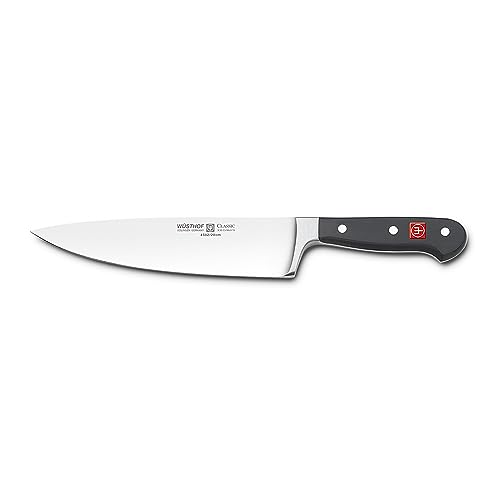
Wüsthof
Wüsthof Classic 8-Inch Chef's Knife
Forged single-piece construction provides outstanding balance and heft
Care and Maintenance Basics
Hone regularly. Use a honing steel before every cooking session to realign the edge. This is the single most impactful maintenance habit. It doesn’t remove metal — it realigns the microscopic edge.
Sharpen less often. Full sharpening (whetstone or pull-through sharpener) is needed every 6–12 months with regular home use. Signs you need to sharpen: the knife slips off a tomato skin rather than biting in.
Never the dishwasher. Heat, vibration, and caustic detergents dull edges rapidly and damage handles. Hand wash, dry immediately, store properly.
Store on a magnetic strip or in a blade guard. Throwing knives in a drawer with other utensils chips edges and is a hand hazard. A magnetic wall strip is the cleanest, most blade-friendly storage option.
Cut on wood or plastic. Glass, ceramic, and stone cutting boards are extremely hard on edges. Use wood (preferred) or plastic.
The Bottom Line
You don’t need to spend $200 to get an excellent chef’s knife. The Victorinox Fibrox Pro at $50 will serve most home cooks superbly. When you’re ready to upgrade, the MAC MTH-80 at $145 is a genuine step forward in performance. Buy either of those, maintain them properly, and you’ll have everything you need.