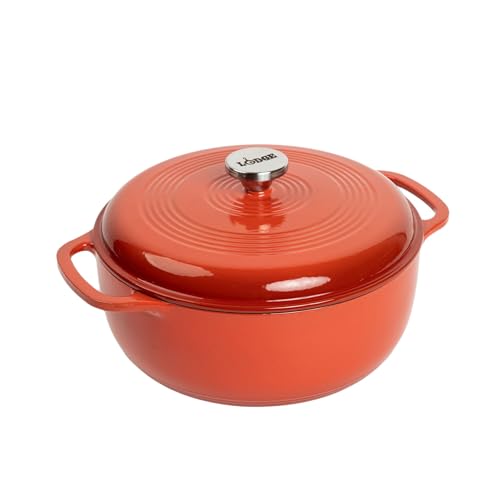
Short answer: buy a Dutch oven if you want one vessel that sears, braises, fries, and bakes crusty bread, and that will still be working in thirty years. Buy a slow cooker if your real problem is time — load dinner at 7am, leave the house, come home to food that cooked itself. The Dutch oven cooks better; the slow cooker fits a life where nobody is home to watch the pot. Cook on weekends? Dutch oven. Out of the house all week? The slow cooker earns its shelf.
Dutch oven vs slow cooker at a glance
| Dutch Oven | Slow Cooker | |
|---|---|---|
| What it is | Heavy lidded pot (cast iron, usually enameled) | Countertop appliance with a low-watt heating element |
| Heat source | Stovetop, oven, grill, campfire | Its own element only |
| Searing / browning | Excellent — sear and braise in one pot | None — must brown in a separate pan |
| Unattended cooking | Oven: generally fine. Stovetop: no | Yes — designed to run for hours unwatched |
| Braises & stews | Excellent, richer flavor from fond | Very good, hands-off |
| Bread baking | Yes — the no-knead / sourdough vessel | No — steams, never crusts |
| Deep frying / stovetop work | Yes | No |
| Lifespan | Decades, often heirloom | 5–10 years, then it’s e-waste |
| Cleanup | Hand wash, heavy to lift | Removable insert, often dishwasher-safe |
| Energy use | Heats a whole oven | Very low — roughly a light bulb |
| Price range | Budget ( | Cheap to mid |
What’s the real difference between a Dutch oven and a slow cooker?
A Dutch oven is cookware. A slow cooker is an appliance. That explains almost every trade-off below.
The Dutch oven is a thick-walled cast iron pot with a heavy lid, usually enameled so it needs no seasoning. Its mass holds heat steadily and it can go anywhere heat exists: burner, 450°F oven, grill, coals. A slow cooker is a ceramic insert in a housing with a low-wattage element, and it does one thing: hold food at a gentle, moist 190–210°F for six to ten hours unsupervised. It cannot brown, cannot fry, cannot go in the oven.
So the honest framing isn’t “which is better.” It’s: do you need a versatile pot, or an unattended cooking machine?
Which one makes better stew?
The Dutch oven, and the reason is fond.
Sear beef in a hot Dutch oven and the browned residue stuck to the bottom dissolves into the braising liquid, becoming the backbone of the sauce. That’s the Maillard reaction doing real flavor work — Serious Eats has documented how much of a braise’s depth comes from that browning step. You sear and braise in the same vessel, so none of it is lost.
A slow cooker cannot brown — its element never gets near searing temperature. You can brown in a skillet first, and good recipes tell you to, but that’s an extra pan, and most people skip it on a weeknight, which is exactly when they’re using the slow cooker. Skip it and the stew tastes gray: tender and flat. A sealed slow cooker lid also traps steam, so sauces never reduce, which is why slow cooker chili usually needs thickening and Dutch oven chili doesn’t.
If braising is your main use, the Lodge 6-Quart Enameled Dutch Oven covers it at a fraction of the premium price, and the Le Creuset 5.5-Quart Dutch Oven is the version you buy once and hand down.
Can you leave a Dutch oven cooking while you’re out?
This is where the slow cooker wins, and it’s not a small point. Slow cookers are low-wattage, thermostatically limited, and designed to run eight hours with nobody home — that’s the entire product. USDA guidance treats all-day unattended slow cooking as the normal use case, provided you start with thawed food and keep the lid on.
A Dutch oven depends on where it sits. On the stovetop, don’t leave it unattended — a hot element under a pot is the classic fire scenario, and the National Fire Protection Association consistently identifies unattended cooking as the leading cause of home cooking fires. In the oven at low temperature it’s generally fine: a 300°F oven with a covered pot inside is stable and contained, and plenty of cooks run a four-hour Sunday braise while they’re around the house.
The practical issue isn’t really safety, it’s comfort. Most people won’t leave an oven running while they’re at work, and that’s a reasonable line. If your window is “gone from 8 to 6,” the slow cooker isn’t a compromise — it’s the only one that solves your actual problem. What it gives you in return is narrow but real: ten hours untouched, almost no electricity, and a kitchen that stays cool in August.
The Dutch oven’s counter-argument is everything else it does — searing and sautéing in the pot you’ll braise in, deep frying (heavy walls hold oil temperature when cold food hits), stock, soup, rice, cassoulet, and reducing a sauce with the lid off. A slow cooker has no move for any of it.
Can you bake bread in a slow cooker?
Not real bread — and this is the clearest line between the two. A slow cooker will steam a soft, pale, cake-textured loaf. It cannot produce a crust, because crust is a function of heat it doesn’t have.
Here’s why the Dutch oven can. Bakeries inject steam into their ovens for the first minutes of a bake: steam keeps the loaf’s surface flexible so it springs upward instead of setting early, and it gelatinizes the surface starches, which later crisp into that glassy, blistered crust. Home ovens vent, so you can’t hold steam in one.
A preheated Dutch oven cheats around that. Heat the empty pot to roughly 450–500°F, drop the dough in, clamp the lid on. The dough releases its own moisture, the heavy lid traps it, and for the first 20 minutes the loaf bakes inside a miniature steam-injected oven. Pull the lid for the last stretch, the steam escapes, the surface dries, and the crust browns and shatters. That’s the whole mechanism behind every no-knead and sourdough recipe calling for a Dutch oven — the pot isn’t a container, it’s the steam chamber.
A slow cooker tops out near 210°F. That’s not slightly short of a bake, it’s a different process: steaming, not baking. No oven spring, no blistering, no crust, and no technique closes the gap.
The standard vessel is a 5 to 6 quart round enameled Dutch oven — roomy enough for a 1,000g boule to spring without touching the walls, narrow enough that the dough doesn’t spread flat. The Lodge 6-Quart Enameled Dutch Oven is the default pick in most sourdough communities for that reason; the Le Creuset 5.5-Quart does the same job with a heavier lid. The Lodge Double Dutch Oven Combo works too, and some bakers prefer it: since one half is a shallow skillet, you can bake on the wide pan and invert the deep pot over the top — far less alarming than lowering slack dough into a 500°F well.
One honest caveat: check your pot’s temperature rating before preheating it empty. Enameled cast iron has a maximum-temperature spec, and the knob matters — some phenolic knobs are rated well below the enamel itself, and several manufacturers advise against preheating an empty enameled pot at very high heat, since thermal shock is what crazes enamel. Lodge and Le Creuset both publish their ratings. If the knob is your weak link, a stainless replacement is a cheap, common fix.
What to skip: the mistakes that cost people money
Don’t buy a slow cooker for food you’d rather braise. The most common regret we see is buying one for short ribs, pot roast, and osso buco — dishes whose whole character comes from a hard sear and a reducing sauce. You get watery meat and conclude you don’t like braising. Save the slow cooker for what it’s great at: pulled pork, beans, chili, shredded chicken, bone broth — anything where “falls apart” is the goal and a glossy sauce isn’t.
Don’t overspend on the enamel. A premium French Dutch oven is beautiful, with smoother enamel and a heavier lid — but a budget enameled pot delivers roughly 95% of the performance for a quarter of the price. The physics of heavy iron under a tight lid don’t care about the badge. Buy the Lodge, cook in it for a year, and upgrade only if you actually find its limits. (Bare cast iron follows the same rule — see cast iron vs nonstick.)
Don’t buy a 4-quart to save money. Too small for a chicken, too small for a real batch of stew, too small for a boule — and you’ll buy a second one. 5.5 to 6 quarts is the size that works.
Which should you choose?
- One pot for everything: Dutch oven. The Lodge 6-Quart Enameled is the value pick; the Le Creuset 5.5-Quart is the heirloom.
- Out all day, dinner ready at 6: slow cooker. Nothing else solves that.
- You bake bread or fry: Dutch oven, no contest.
- Hot climate, no AC: the slow cooker keeps your kitchen cool.
- You want a second pan too: the Lodge Double Dutch Oven Combo, or pair a pot with a Lodge 12-inch cast iron skillet.
- Most people who cook seriously: Dutch oven first, a cheap slow cooker later if your schedule demands it. One is a lifetime tool, the other is a convenience.
Our best cast iron cookware rankings compare every pot and skillet side by side, and the cast iron care guide covers upkeep for enameled and bare pieces alike.
Frequently asked questions
Can you use a Dutch oven as a slow cooker?
Yes, in the oven. Set it to 250–300°F with the lid on and a Dutch oven mimics a slow cooker closely, often with better texture because a little liquid reduces. The difference is supervision — you’re running an oven for hours, so it works best when you’re home. On the stovetop, the lowest burner setting is usually still too hot to leave alone.
Is a slow cooker cheaper to run than a Dutch oven?
Considerably. A slow cooker draws roughly 150–250 watts on low, about the same as a couple of light bulbs, while an oven pulls kilowatts and heats an entire cavity. Over an eight-hour cook the difference is real, and in summer you also avoid heating your kitchen.
Do you have to brown meat before slow cooking?
You don’t have to, but the dish is noticeably better if you do. Browning creates the Maillard compounds and fond that give a braise depth; skip it and you get tender meat with a flat, one-note sauce. Since a slow cooker can’t brown, that means an extra skillet — the step a Dutch oven eliminates by doing both in one pot.
How long does a Dutch oven last compared to a slow cooker?
A Dutch oven is effectively a lifetime purchase — cast iron doesn’t wear out, and chipped enamel usually affects looks more than function. A slow cooker is an appliance with an electrical lifespan, typically five to ten years before the element, thermostat, or cord fails, and it isn’t repairable.
What size Dutch oven is best for sourdough?
A 5 to 6 quart round enameled Dutch oven is the standard. That range gives a typical 900–1,000g boule room to spring without hitting the sides, while staying narrow enough that slack dough doesn’t spread into a disc. Under 4.5 quarts crowds the loaf; much larger and the dough flattens and the steam disperses.