Short answer: an air fryer is worth it if you cook small batches, live on frozen foods and weeknight crisping, or want fries and wings without waiting 12 minutes for an oven to preheat. It is not worth it if you already own a good convection oven and mostly cook for a family — because an air fryer is just a small, fast convection oven, and a basket that only crisps a single layer will slow you down on anything you’d actually roast in bulk. The honest split is speed and convenience versus capacity. Match the tool to how you cook, not to the marketing.
Air fryer vs oven at a glance
| Air Fryer | Full Oven | |
|---|---|---|
| How it cooks | High-velocity convection | Radiant + (optional) convection |
| Preheat time | ~2-3 min (often none) | 10-15 min |
| Best batch size | 1-2 servings, single layer | Whole meals, sheet pans |
| Crisping | Excellent — fast, even | Good with convection, slower |
| Energy per session | Lower for small loads | Higher — heats a large cavity |
| Frozen foods | Faster, crispier | Works, but slower |
| Baking (cakes, breads) | Poor — cramped, drying | Purpose-built |
| Cleanup | Small basket, dishwasher-safe | Larger, more surfaces |
| Counter space | Takes a permanent spot | Already installed |
| Best for | Weeknights, singles, couples | Families, batch cooking, baking |
What is an air fryer, really?
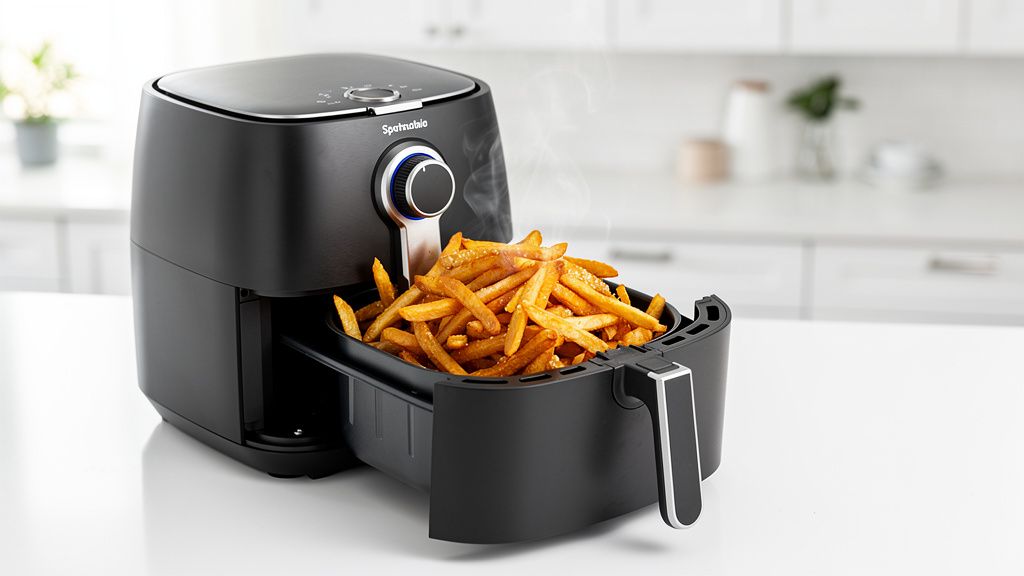
Here is the part the box won’t tell you: an air fryer is a compact countertop convection oven with an aggressive fan. Nothing is fried and there is no oil bath. A heating element sits above a small chamber, and a powerful fan blows hot air fast around food in a perforated basket, so the surface dehydrates and browns the way deep-fried food does. That is the entire trick — velocity plus a small cavity.
Because the chamber is tiny, it heats in seconds and airflow hits food from all sides at once. A Ninja AF101 or Cosori Pro LE reaches temperature almost instantly, where a wall oven wastes 10-15 minutes heating a cavity many times larger. Your oven does the same job with convection on — just slower to get there and slower to crisp, because it has far more empty air to move. Once you internalize “small fast convection oven,” most of the buying decision resolves itself.
Is an air fryer faster than an oven?
Yes, meaningfully — and preheat is where most of the gap lives. A full oven spends 10-15 minutes reaching 400°F before you even put food in. An air fryer is essentially ready when you press start, so a tray of frozen fries that takes ~25 minutes end to end in the oven is on your plate in 15 from a cold basket.
The cook time itself is closer than people assume. Once both are hot, high-velocity air and a small chamber still win, but only by a few minutes. The real advantage is that you skip the wait entirely for the small, fast tasks air fryers are built for.
Is an air fryer cheaper to run than an oven?
For small batches, yes. A typical air fryer draws roughly 1,200-1,700 watts but runs for far less time and heats a tiny space, so a single-serving job costs a fraction of firing up a full oven. The U.S. Department of Energy notes that a conventional oven is one of the larger energy draws in the kitchen, and heating that whole cavity to cook two chicken thighs is pure waste.
But the math flips with volume. Cooking for four means two or three sequential batches, at which point you’re running the machine longer than a single oven session that fits everything on one sheet pan. Air fryers are cheaper per small job, not per meal — cook for a household regularly and the oven claws the efficiency back.
What do air fryers genuinely win at?
Four things, decisively:
- Frozen foods. Fries, nuggets, spring rolls, tots — anything engineered to crisp comes out better and faster from an air fryer than a home oven. This is the single strongest use case.
- Wings and small proteins. The high airflow renders fat and crisps skin in a way a home oven struggles to match without a broiler and constant attention.
- Reheating. Leftover pizza, fried chicken, roasted vegetables come back crisp instead of soggy — a task the microwave ruins and the oven overkills.
- Small-batch crisping. One or two servings of roasted broccoli, tofu, or chickpeas, ready without preheating a giant cavity.
If your cooking skews toward any of these, the convenience is real and daily. A Ninja AF150 earns its counter space for a household that eats this way.
Where does a full oven still win?
Batch size, whole meals, and baking. A sheet pan of vegetables for four, a roast chicken, a tray of cookies, a lasagna, anything that bakes — the oven wins outright because it has the space and the steady radiant heat that air fryers lack. Air fryers dry out cakes and quick breads, crowd anything larger than a couple of servings, and force you to cook in shifts. A Breville Smart Oven Air Fryer Pro splits the difference — an oven-style unit with real capacity and an air-fry mode — but a full-size oven still holds more and bakes better.
Basket vs oven-style: which format?
Two designs, two philosophies. Basket air fryers (the Ninja AF101, Cosori Pro LE, Ninja AF150) pull a drawer out, shake, and go — smaller footprint, faster, dishwasher-friendly, best for the crisp-and-reheat jobs above. If you want two things at once — protein and a side finishing together — a dual-basket unit like the Ninja DZ201 Dual Zone runs two independent zones. The Instant Vortex Plus is a strong single-basket all-rounder.
Oven-style air fryers (like the Breville) trade compactness for capacity and versatility — racks, toast, bake, and air-fry in one larger box. They earn their space if you want a genuine second oven, not just a crisper. Our air fryer buying guide breaks down sizing for your household.
What to skip: don’t buy an air fryer you don’t need
Here is the honest part most review sites bury: if you already own a good convection oven, you may not need an air fryer at all. It is the same technology in a smaller box. Turn your oven’s convection setting on, roast on a wire rack over a sheet pan for airflow underneath, and you’ll get 90% of the crisp for the frozen and roasted foods people buy air fryers for — with more capacity and no new appliance eating your counter.
And resist the urge to buy the biggest unit on the shelf. Oversized air fryers defeat their own purpose: a large basket you fill in a single layer still only crisps one layer, so you’re heating more air for the same result, and anything you overload steams instead of crisping. If you find yourself batch-cooking in an air fryer to feed a family, you bought the wrong tool — that’s an oven’s job. Buy the smallest air fryer that fits your real portions, and let the oven handle volume.
Which should you choose?
- Singles and couples, frozen-food heavy: an air fryer, easily. The convenience is daily and the batch limits never bite. Start with the Ninja AF101 or Cosori Pro LE.
- You want protein and a side done together: the Ninja DZ201 Dual Zone — two independent baskets, one finish time.
- You already have a good convection oven and cook for a family: you probably don’t need one. Try convection-on-a-rack first before spending the money and counter space.
- You want a true second oven, not just a crisper: an oven-style unit like the Breville Smart Oven Air Fryer Pro.
- You cook mostly whole meals, sheet pans, and baked goods: the oven remains your workhorse — an air fryer would be a rarely-used gadget.
Still deciding? Compare every model side by side in our best air fryer rankings, then size it right with the air fryer buying guide.
Frequently asked questions
Is an air fryer just a small convection oven?
Essentially, yes. Both cook by blowing hot air around food. The air fryer’s advantage is a much smaller chamber and a more aggressive fan, so it heats instantly and crisps faster. A full-size convection oven does the same job with more capacity but a longer preheat and slightly less intense airflow.
Does an air fryer use less electricity than an oven?
For one or two servings, yes — it heats a tiny space for a short time. For a full meal it can use more, because you cook in multiple batches while an oven fits everything at once. Air fryers save energy on small jobs, not large ones.
Can an air fryer replace my oven?
Not fully. It handles crisping, reheating, and small-batch roasting brilliantly, but it can’t bake well, can’t fit a sheet pan or a roast, and forces batch cooking for a family. Think of it as a fast supplement for weeknight tasks, not a replacement for the oven.
What can’t you cook in an air fryer?
Anything large or delicate: cakes, quick breads, and pastries dry out and cook unevenly in the cramped, high-airflow chamber. Big roasts, casseroles, and full sheet-pan dinners simply don’t fit. Wet batters blow around before they set. Those all belong in a real oven.
Are bigger air fryers better?
Usually not. Air fryers crisp best in a single layer, so a huge basket you can only fill one layer deep just heats more air for the same result — and overloading it steams food instead of crisping it. Buy the smallest size that fits your typical portions; if you need to feed a crowd, that’s an oven’s job.